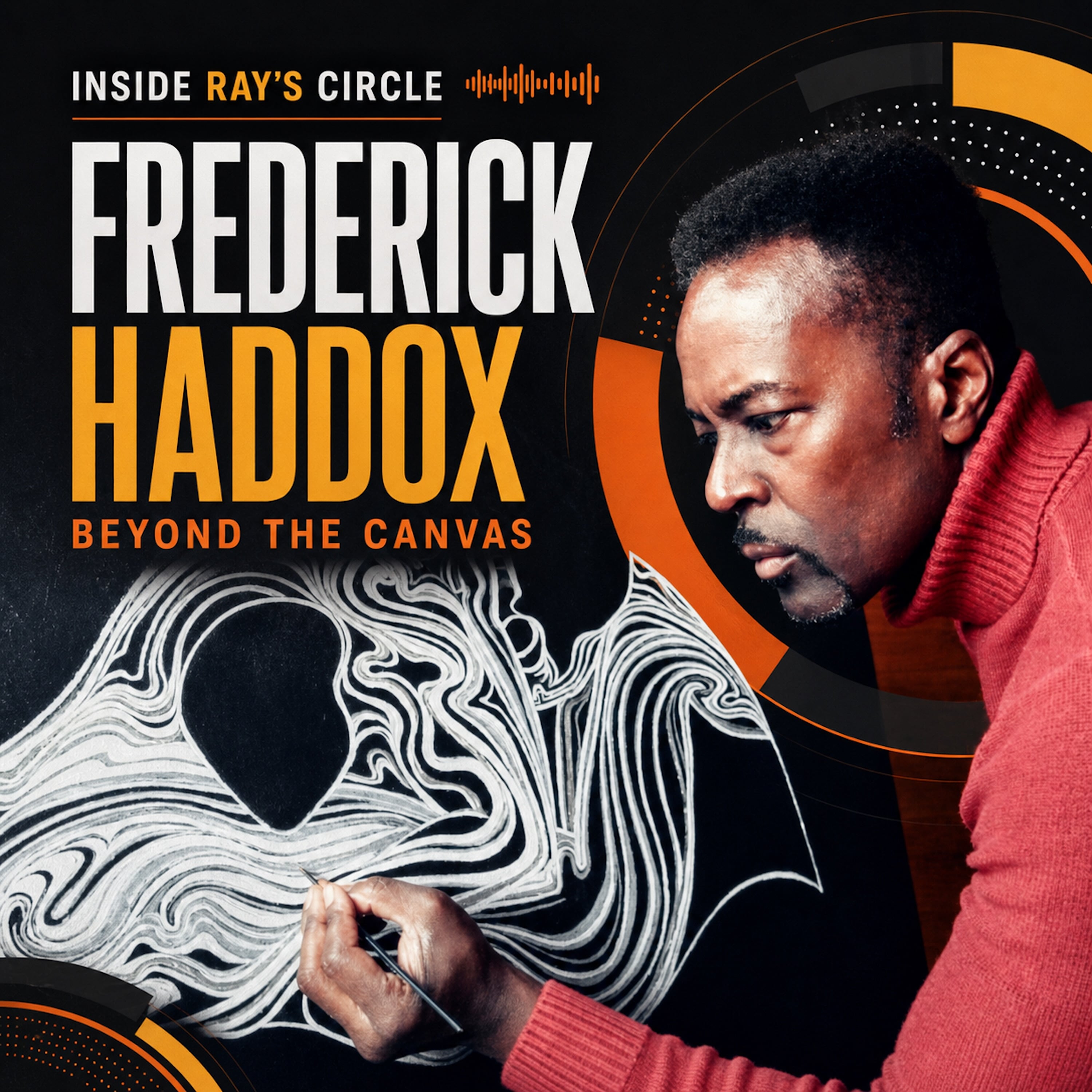
Frederick HaddoxI just want to be at a point where, when you see it, you know it's me, and when it's not about knowing about art. I think the biggest deterrence from people who see art, even on a daily basis, or what I'm doing, they think, "Well, I don't know anything about art," so they just don't even step in that direction. And it's not about your knowledge of it. We're used to that. So it's about what you feel. So if I could put it anywhere and people feel my work, I would appreciate that. But also, too, among people who do art, it would be nice if they knew I had game.
Ray BrownFirst of all, I'd like to introduce this gentleman here, Frederick. Talented painter, talented individual. Seems like quite the intellect. I've always been wanting to talk to you face-to-face, have a conversation, and I figured, why not do it in a space that we can just kind of sit back and have coffee? I know it's not Folgers Crystals, as I mentioned earlier, but we can have this kind of feeling, we back home someplace, right?
Frederick HaddoxYep.
Ray BrownCheers to you. Right on. Let me get me a little sip real quick. Where are you from originally?
Frederick HaddoxI was born in Memphis.
Ray BrownMemphis, Tennessee.
Frederick HaddoxOh, yeah.
Ray BrownWow.
Frederick HaddoxOh, yeah.
Ray BrownI know Memphis.
Frederick HaddoxOh, I bet you do.
Ray BrownWow.
Frederick HaddoxThe music and, yeah, yeah.
Ray BrownAbsolutely, yeah.
Frederick HaddoxAnd so I was only born there.
Ray BrownOkay.
Frederick HaddoxMaybe a couple months after, I moved to Michigan. My father was working in a trucking factory in Pontiac.
Ray BrownOkay. Okay. Oh, so Detroit then?
Frederick HaddoxYeah.
Ray BrownOh, wow, yeah. So that's when Michigan was a... Detroit was kicking because that's when they were doing all the manufacturing before everything closed back down and stuff, man.
Frederick HaddoxOh, yeah. Yeah. Mm-hmm.
Ray BrownAnd so how long did you stay in Michigan?
Frederick HaddoxUntil middle school.
Ray BrownOkay, okay.
Frederick HaddoxAnd then, so my father, he was at the time working in the factory. But he was also taking courses at University of Detroit because he was wanting to get into med school. So he ended up going to med school at Michigan State, so we moved there for a while. And then after a while, he had residency in Kalamazoo, and then after that he went in the military. So we, well, he went in when he was like 19 and he went out again. And so he went just back in the military. And then this time as a doctor, so he was working...
Ray BrownOkay. Mm. Wow. Okay. I see. Oh, so he went as a doctor in Southern Dr... Okay, after he got his graduate and stuff. Wow.
Frederick HaddoxYeah. Yeah. So... Yeah. So he ended up going to the Naval Medical Hospital in Bethesda, Maryland, which is right outside of DC. So then we moved there. So... And I've been in that area ever since, until that time I left for Hungary.
Ray BrownWhat a driven man. It's... Okay. Oh, okay. I see. Wow. I see. Interesting. So your dad was a military man to start off with, and then he decided to be a civilian, raise his kids.
Frederick HaddoxMm-hmm. Yeah, he's interesting. I mean, basically, a lot of it, I think, was to avoid farming. He grew up on a farm.
Ray BrownOkay. All right. Where is he from originally then?
Frederick HaddoxThey're from, well, from Tennessee.
Ray BrownOh, Tennessee too.
Frederick HaddoxAll of our family's from Tennessee. So. Yeah. Uh-huh.
Ray BrownOkay. Oh, wow. Okay. Wow. Interesting. Wow. And do you have siblings?
Frederick HaddoxNo.
Ray BrownOkay. Just you. Oh, man, you's a little spoiled. Were you spoiled growing up, or...?
Frederick HaddoxMore or less. I mean, I don't know what it's like to have a brother or sister, so I can't make the comparison. But from what people tell me.
Ray BrownI see. Sure, sure. Yeah, yeah. I'm the oldest of six, so. Yeah, yeah. And they were divorced and married, so I got steps that just keep going. You know? So yeah. Wow. Were you doing art in school?
Frederick HaddoxOh, wow. Mm. Art was always the base, what I did. Like a backbone. It was always that. So it was just more like what else I was doing besides that.
Ray BrownMm. Okay. Okay. Okay, okay. So you were doodling in school? How did you start? You was like making portraits in school, or?
Frederick HaddoxNo, I used to... My father's pretty good at drawing. So we used to draw together when I was like five. And so we would just draw, and it would always frustrate me because I could never draw as good as him. I used to get angry and upset and all that. And, you know, one thing he told me, because he died a few years ago, and...
Ray BrownOh, okay. Oh, wow. Ooh, I'm sorry.
Frederick HaddoxThat's all right, yeah. Before he died, somehow, I forgot how I learned it, but he used to take the drawings that I would make with him. He used to take them to the school where he was, medical school, because the other students wanted to see the drawings, the medical students. So they were just like... share with more, and I had no idea about any of this.
Ray BrownMm-hmm. I love it. When you graduated high school, did you have plans of staying where you were? I mean, obviously you didn't because we're here in Budapest now, but...
Frederick HaddoxWell, yeah, because at that time my primary interest was animals. I wanted to be a veterinarian.
Ray BrownOh. Did you have animals growing up, quite a few?
Frederick HaddoxWell, I grew up with asthma, so it wasn't easy. So I had, I think I had everything except a dog, a cat. I think I had a bird for like a couple weeks, but that wasn't gonna work.
Ray BrownOkay. And so then out of high school, what was life...? Did you go to college, or?
Frederick HaddoxYeah. So I went to George Mason University, so that's in Fairfax, which is outside. Yeah.
Ray BrownOkay. Fairfax, okay. Okay. And your major there, was it art?
Frederick HaddoxNo, it was actually biology. And I was taking a lot of English courses. I was enjoying those. And also at the time I was working in an animal hospital.
Ray BrownOkay. Preparing to be a vet, basically.
Frederick HaddoxYeah. It's experience, yeah.
Ray BrownI see. And why English courses? What was your fascination with...?
Frederick HaddoxOh, wow. I think that growing up I really wasn't that good at math, and I was stronger in English. But there was a point where I was told that I'm pretty good at this and I should study this, and I started taking advanced courses in placement and all these different things. And it was one of those things where I think it's a part of our culture. It's often considered that we're not too prone to excelling in English. So, yeah, my father, since he's one of these people who did this, and he's a doctor, and he also wrote a poetry book. Yeah, that was a big deal at the time. Yeah. So, you know, I was taught to be an example. And so it was one of these things where I thought, "Okay, I'm pretty good at this. I should stick with it," and that's why.
Ray BrownSure. Sure. Yeah. Your father did? Wow. Okay. All right. Oh, okay. Obviously, your father meant quite a bit to you.
Frederick HaddoxYeah.
Ray BrownYou guys were obviously very close growing up. Was your mother in your life as well?
Frederick HaddoxOh, yeah. Mm-hmm.
Ray BrownOkay. And what was her life...? Were they married?
Frederick HaddoxYeah, they were. Yeah, I actually had... I was fortunate like that. Yeah, it's just...
Ray BrownOkay. So that's interesting. That's awesome, man. Yeah. It's an interesting dynamic, you know, when you have both parents in the house. I think that's a beautiful thing. Was your dad really strong in motivating you to do the things that you wanted to do? Or did he have... What was his energy like with you?
Frederick HaddoxHe really cared about me wanting to do whatever I loved, technically. I think the only thing I kind of wish he had done differently, he really didn't instill a killer instinct in me. So, I mean, he did grow up playing baseball. Even got, like, a college scholarship for it and everything like that. So he was good at it, but he never... He was more like, "As long as you tried your best at what you play," and everything like that, and that matters more. And so I was more, I think it made me more effort-driven. So I was really good at starting stuff, really good at doing the work, but as far as just sealing the deal and finishing off...
Ray BrownOkay. Yeah. Okay, okay. And was he that type of individual or quite the opposite of that?
Frederick HaddoxHe could finish. He was driven, but he wasn't maniacal about it. He just... Uh-huh. He really didn't want to put his standards on me in that way. So I felt as though he really tried to... He wanted me to be better off than he was. So he grew up on a farm outside of Nashville. And he was a baby when he was brought into the house that was on the land. So ever since he could walk around, he was doing something. So he was always working on it, and he was really good at it, but he just wanted more. He had other fascinations. My grandfather, it was more about my father didn't want to hurt his feelings.
Ray BrownWas he driven? Yeah? Uh-huh. Okay. Okay. Gotcha. Uh-huh, uh-huh. Gotcha. Oh, I see. I see. Mm-hmm. Mm-hmm, mm-hmm. Wow. Hmm.
Frederick HaddoxBecause if someone has been doing this and trying to provide for people, I mean, he basically bought the land. It had trees. He cleared it himself. He grew everything on it. He got the animals, and he did all this stuff. Yeah. And he worked a full-time job at night. So it's kind of like... he's doing all this. So to say you don't want to do that, he didn't want to insult him. Because he knew this was part of how he was able to survive growing up, yeah.
Ray BrownMm-hmm. Your grandfather? I understand. Hmm. Yeah. Yeah, yeah. Mm-hmm, mm-hmm. I see. Yeah. Yeah.
Frederick HaddoxOne thing that was difficult for me, culturally, in a way, because going to Michigan at that young age, it was like outside my home is the North, but inside's the South. I was this sort of weird mixture of things. So whenever I would speak, it was considered odd in a way by the people around me. And then because a lot of the people around me grew up in the North, and even Black people. And then when I got to DC, that area, even more questions. And then when I, you know, so where I carried it with me as I collected these things.
Ray BrownMm-hmm. Hmm. Right. Gotcha, gotcha. Mm-hmm. Sure. Obviously not too far removed from your grandfather, you know, slavery, right? Right? So do you know what plantation?
Frederick HaddoxYeah. Uh-huh. No, I don't know that. I think that was a big part of what my father was trying to do the last 10 years of his life, was trying to connect the land he was on, because there were slaves there, and it was a plantation, to the possible relatives we had. And just trying to put those pieces together.
Ray BrownOkay. Hmm. That's commendable, man.
Frederick HaddoxMm-hmm.
Ray BrownIt really is. I was over at the MOM Park in Budapest. I'm trying to get into this restaurant that has a little night thing happen. I think it's, I forget the name of the restaurant. I tried to get in. They wouldn't let me in, and I don't think it was anything other than it was just really busy in there. I mean, okay, I'm an outsider as well, but it was busy in there. And then there was another gentleman who also couldn't get in. When we was having conversations, he's talking to me, he said, "Where are you from?" Said, "I'm from the US." "Oh, really? What part?" Said, "I'm from LA." He said, "Oh, that's great. Oh, wow." He said, "So, but you're Black, right?" Said, "Yeah, yeah." "So where are your ancestors from?" And I was like, "Well, I really don't know." And he was like, "I mean, really, where are they from? You can tell me." I was like, "No, no, I really don't have any idea. I mean, I'm from California. My grandparents were from Alabama." He really didn't take my answers as being serious, and I realized, wow, he really doesn't know what I'm talking about. So then I had to break it down with him. I said, "Look, my name is Brown. That's my last name. That name came from the last family, not the only family, the last family that owned us." Yeah. Yep.
Frederick HaddoxMm-hmm.
I get it. He says, "I never even thought about that. How did you end up here?" I was going to a liberal arts school, which tends to introduce you or requires that you take other types of non-Western cultures and different things. They make you go outside of your sphere, so you can't just study one thing and that's it. And I loved that anyway. And so I started to... I did take some art courses. And at the time, I would say from the end of high school to the beginning of college, I was really into comic strip art. I drew comics, wrote them for the school paper through high school. I was running around trying to get some sort of syndication in universities, trying to get that going, and I wasn't having much luck with it. I mean, I got into a few papers, but it wasn't enough to be picked up. At the time while doing that, I still had this interest in art that I was carrying. I had worked on this graphic novel, and at the time I was working on it, graphic novel was not a term that was universally known. It was still only within the comic society knew that. I made it in collage, and it was on these poster boards, can be displayed. So this was an extended study project. I was able to get credit in school for it. I had an advisor. And my advisor was really cool because I also took film. Like imagine Tarantino being your film teacher, in a way. So it's not, you know, we know about classic stuff, but she also does this. So she see how I frame characters and do these different things. And while that was going on, we also had a university gallery, and I was a curator for that. It was in the art department. And so I approached him with it, and he said, "Wow, this is something." He said, "Okay, you want to talk to this other guy." His name was David Chung. Have you heard of Æon Flux? That Æon Flux was an animation that was put out by MTV. And then it became a movie with Charlize Theron in it maybe 10 years later or whatever. This guy, you know, they're brothers. So the guy Peter Chung did that. So he's all, he can go to Japan. They'll give him what he wants. He's that good, so he does... Yeah, he's serious. I met him. He saw the work and said, "Okay, you're coming to my course." It was like it was a high-level course. I hadn't taken anything in between, since you're just coming here. So I end up going there. I don't know. I met... I think, well, yeah, part of it had to do with a girl from Stuttgart, which is like the south... more, yeah. And so she told me about her favorite artist, this guy named August Macke. And so I got to know who that was. Once I looked into this thing called German Expressionism, I started seeing other people I liked, and I decided to take a course in it. I thought there's something about these artists that I kind of felt an inner connection to. Because a lot of them were not originally artists. They weren't... And it wasn't until their adulthood they wanted to pursue that. Some were architects, some studied theology and law, and they focused more on the form and the color and the feelings that brought out rather than the composition. Yes, and so I decided, maybe I should go to school there. And it was a really hard decision because I had just maybe half a year taken my MCATs. Yeah, because I stopped pursuing veterinary medicine, and I think that when you work in an environment like that, I almost felt like I had done that. I was by that time the technician. I could do almost everything I want to an animal besides what doctors could do, and I would talk to doctors. I would know their own personal struggles and what they went through and this and that. So I felt like, in a way, I lived experience vicariously or through these people anyway. So, and it was always... and to me, medicine's medicine. I grew up with asthma. I was in the hospital quite a bit. And I tend to hang on to minutiae, small things. I'm really big about details in a way. I decided, okay, I'm gonna do this. And then, but when I took that exam...
Ray BrownHmm. Okay. Okay. Whoa. Mm-hmm. Hmm. Oh, wow. Hmm. I haven't. Okay. Hmm. Hmm. Okay. I know Stuttgart, yeah. Sure. Interesting. So you were influenced by these German artists? Wow. Hmm. Hmm. Hmm. Mm-hmm. Were you, but before, were you concerned about your father's blessing on it? Did you think about... or it didn't matter because your dad was behind you 100 percent no matter what?
Frederick HaddoxOh, no. Yeah, exactly. Yeah, when I told him I wanted it, he was kind of... I almost think he was disappointed in a way. My father had a very romantic idea of vets. And how, because when he was in medical school, they told him, "You see those guys over there? They're veterinary students. They work twice as hard as you. They gotta learn all this other stuff on how to do anything, too. So you don't think you got it rough." So he took that with him. And he said, "Wow, I didn't..." He said, "I never thought about that." And he said, "I think you'd be good at this. And I mean, if you have any questions, ask me," blah, blah, blah. But, you know, he... Yeah, he was. And so, but after taking that exam and then I started getting these other artists and the other work I was doing, I was thinking, "You know, I really like storytelling. I really like the feeling I get from doing that." And it was more about which one could I do that would have a greater influence on people. What could I bring more to the world being, you know? Mid-20s. Oh, yeah. Yeah. Yeah. I didn't really have... Because it took me a long time to get through school because I studied a lot of different stuff. I had to stop in between to work. And so it took longer than it should have, but... in that time, like you said, I was older. I was able to make these...
Ray BrownOkay. Mm. Mm. Mm. Very supportive. Right on. Mm. Mm-hmm. Mm-hmm, mm-hmm. And how old were you at this point? Really? And you were thinking like that, huh? Wow. Interesting. Okay. I see. Mm-hmm, mm-hmm, mm-hmm. Right. When was it that you bought the ticket? Like, when, what was that transition of actually saying, "I'm coming over," or was there...
Frederick HaddoxI bought the ticket in the middle of the course because not only was I taking German art, I was taking German literature. And I was actually taking language for a while. But they made me stop. I couldn't do that because I had to continue with Spanish, which I started. So I was absorbing myself in a way already. Yeah. And when I got the ticket, you know... Of course. Yeah, and of course my art history teacher who taught German Expressionism, yeah, so he was just... told me what to look out for, what to do, you know.
Ray BrownMm. Okay. I see. And you were preparing yourself to... you knew you were leaving at some point. It was like... made it real. Hey, man, don't gloss over this too fast now, because this is your first trip, like going out of the country, right?
Frederick HaddoxOh, okay. All right. I didn't, you know, I didn't... I mean, of course I've been to Canada, because it's right there. But I know what you mean. I mean, the first foreign country across the Atlantic, it was Iceland. Had to... Had to go to Reykjavik on the plane. It stopped over. It was like a layover in Iceland. I'm there looking, and I'm experiencing. I'm looking out the windows. I'm looking at everything. And just like, wow, this is nice, you know? And it's kind of like the moon there. And then went to Germany. And I just know the first time I was about to speak German, and there were these two guys, and they're sitting down on a bench. And I go up to them to ask, "Where's the bank?" And so I say to the Germans, "Where's the bank?" Yeah, in German, and they looked at me and they kind of smiled. And I didn't realize why, and that's because the German word for bank is almost the German word for bench. Bench. What they were sitting on when I asked them. Yeah, so they were kind of... And I didn't know it until I got back home and was told about it. Yeah, but it was nice to be somewhere where even though they spoke German, they would try to speak English, and I would try to speak German. And we met halfway. And I really felt... and yeah, so that was really nice to experience. But I mean, I spent quite a bit of time going to museums and looking at certain pieces and certain things, going to schools, and I drew quite a bit. Two weeks. I guess that first feeling of freedom. I didn't feel trapped in the US. I wouldn't say that, but it's just a different feeling being there and moving around and interacting with people who were completely different from you as far as, you know, background and things. And it was just pleasant.
Ray BrownYou didn't think about that, huh? Yeah. Yeah. What was the experience like, actually? Like, just... Before... Oh, I see. Gotcha. Awesome. Mm, mm. Mm-hmm. In German. For bench? Oh, wow. Oh, okay. Oh, okay. Mm. Mm. Mm, mm, mm. Mm-hmm, mm-hmm. Mm, mm. Mm-hmm. How long did you stay? Oh, two weeks, okay. Gotcha. Okay. Mm-hmm. Okay. Mm-hmm. Gotcha. Mm-hmm, mm-hmm. Did you grow up in a multicultural environment?
Frederick HaddoxNo. When I lived on the medical school campus, the college campus, my mother and I, we all lived there, and there were people from everywhere. And I went to a kindergarten where there were people from everywhere. So when I was five or six and still being... Yeah. No. Kalamazoo. It's in Southwest Michigan. It's basically a very large Dutch population, and there I went to a private school, a Catholic school, for about five years, the only Black male in the school. So I was immediately dumped from one, you know... yeah, yeah, to another one. Yeah, exactly, and it's just like, whoa, you know? And, you know, of course they reacted on it, too. For the first two or three years, yeah. Because you had to not only contend with students, but also teachers. Mm-hmm. And we don't tend to think about it in terms of we're used to giving children a pass for not knowing any better or not being taught. But those adults were children too in the same situation, so... Exactly. Yeah. Mm-hmm.
Ray BrownOkay. You experienced something. But in between that... not so much. Mm-hmm. Mm-hmm, mm-hmm. One extreme to the next. Sure. Yeah, yeah. Was that hard? Okay. All right. Interesting. Mm-hmm. Probably even worse sometimes, because they know better. Yeah, and still do. I understand. I came up in a multicultural environment for a majority of my childhood growing up, and that was in the home. So by the time I was maybe 15, I was shocked when somebody told me that people may not like me because of the color of my skin. I thought that was the craziest thing I ever heard. It's like, because my brother that was in my home, he was... My stepmother, which is his mom, is white, so for me, that was my brother. I didn't think about anything racially, and we had this multicultural environment. So those kinds of things, I almost was kind of mad that I wasn't brought aware of that. You know what I mean?
Frederick HaddoxMm-hmm. Mm-hmm. Oh, wow. Okay. Yeah, I wasn't given that information. I almost think... I'm very parted with this. Sometimes I think it's good, sometimes think it's not good, you know, when you're given all this information at a young age before people even do anything to you. And then you have this backlog you can go to, you know? Because when I was in school, when I was the only one there, I was told all the time why. It wasn't the multiculturalism in that way that had an effect on me. It was more the behavior. These kids were much more violent than what I'm used to. I know where I was in school, we'd have a fight maybe once every couple months, where there'd be like three, four fights a day. But we, we... I never saw it as culturally driven. Although I... when you're that old, you do tend to wonder how come some people get attention more than others. And so I think if you dig deeper into it, it probably was in a way culture-driven, but...
Ray BrownHmm. Oh, I gotcha. Okay. Interesting. Okay. I see, I see. But, but... But was it culturally driven or just kids doing kid things? Okay, okay. Oh, yeah, yeah. Yeah. Okay, okay. Gotcha. Yeah, this is all so interesting, man. You spent two weeks in Germany. You came back home. When did you decide that you needed to be traveling again and spending more time here? Or was there an opportunity that presented itself to allow...?
Frederick HaddoxYeah. Well, okay, what happened was, I can't tell you why I did this. It was a bit odd. But when I was applying to these art schools in Germany, I made my own portfolio. I kind of said, "Oh, I love this," da, da, da, da about art and German art and this and that. And I made my portfolio based on what I thought they might want to see. And also, too, I didn't know at the time that it's harder being a foreigner outside the EU and getting into art school because of EU agreements and stuff. So all these other countries, the students get a much closer in line to actually do it. You know, I didn't know any of that. And so that didn't work out. And at the time, I was working in a cafe. In the US. Yeah, still, I'm working in a cafe. And a colleague of mine I worked with was Hungarian, and she was a schoolteacher. And she... Yeah, exactly. She was a teacher in Miskolc. And she had... There were teachers in her school that would come that were native English speakers, so she knew how I could do that if I wanted to go somewhere. Yes, and then the most... Yeah, and it was this very absurd thought came in my head. Everyone finds it funny. And I don't believe... I might have told you. I might have forgotten. I don't know. But I said, in my mind, I thought, "Okay, Hungary's not that far from Germany. It can't be that different." I most certainly did. Oh, yeah. Yeah. So I went through the process of getting into this program and getting the requirements I needed so I could teach in Hungary. Yeah. And, yeah, it wasn't so much of a leap, just because you did have to pay to be on the program and do these things, so. Yeah. Yeah. It was a way to get kids out of college... I did, yeah. I did. Well, actually, no. I was in the countryside for half a year. Oh, yeah. Hatvan. Hatvan. It's 60. Because it's 60 kilometers from the capital. Oh, you had to have gone through there. The train station's there. That's the whole corridor. Uh-huh. Oh, wow. Yeah. Yeah. Yeah, I then left the program, I found a job at an international school. And then I went there. Yes, it was. Yeah. No. I have a theory on that. I tell everyone, you know, if you plan on being here for a year, you're here for two. If you plan on being here for two, you're there for about three. Three, five. It just exponentially grows. They have a way of... And just as you have had enough and are ready to go, something decent happens to make you stay some more. Ready to go. Something happens to you, makes you stay for more. Yeah. Yeah.
Ray BrownI see. I see. In the US? The US, okay. Like born in Hungary? Oh, interesting. The lights clicked off. Do tell. Oh, I love it. I love it, I love it. I love it. Oh, gotcha. So they obviously approved you, and then you got on another plane. Bought the ticket. Okay. Oh, I see. I see. Oh, I see. Gotcha. Yeah. Okay. I see, uh-huh. But you took advantage of it, and... and then found yourself in Budapest. Oh, really? What town? I've never even heard about it. Wait a minute. How do you spell it? Oh, okay. Wow. Oh, that's right. Oh, you know what? I do know that town. I have. I was just there. No, because I just remembered Hatvan means 60, because I... Now I'm showing my stupidity. I don't know Hungarian, so I will probably never know Hungarian. Who knows? But I just learned Hatvan meant 60. And so I remember that town because of that. That's right. Yeah. So that's the town you were in. Wow. For six months, you said? Half a year. And then you eventually came to Budapest at some point. Wow. Oh. Gotcha, gotcha. That's about the time I probably met you then. Okay. Yes. Wow. Wow. You know, different roads we've taken, and we're here. It's amazing, really. When you got here, did you plan to stay? Happy to hear it. Mm-hmm, mm-hmm. Yeah. Absolutely. Yeah. Because you're pulled back in. Yeah. Yes. Yeah. No, I hear you. So it kept, so you know, like that mafia, I mean, The Godfather, "When I want to leave, they keep pulling me back in." Yeah. So obviously things kept pulling you back in.
Did you ever imagine that you would go back home? Or did you think, "I want to explore other places," or did you even try to explore other places? For me, one of the places I wanted to spend more time at was actually the continent of Africa. I actually wanted to hit some of those countries. I did go to South Africa. I went to Soweto. I went to Joburg. I went to Cape Town. But I wanted to go to Uganda. I wanted to go to Rwanda. I wanted to kind of go to Ghana, you know? I wanted to see all these places and just kind of do what I did here. Just go there, sit there for at least six months, you know? To a year, and just be on the ground floor. See what's going on there, see how I can... Any situation I'm in, I'm always trying to think about contributing, you know? Get my skill sets, learn some things. And that's still kind of on the agenda, so to speak, but are there places that you have...? Did you...?
Frederick HaddoxOkay. Uh-huh. Mm. Yeah. Mm-hmm. I was fortunate just because I would say maybe a few years after I went, like maybe in 2007 or 2008, I went to Japan for a few months. Yeah. To work, so. That's the nice thing about teaching, you can always just move there, physically be there. It forces you to be on the ground. So I've always been fascinated with that, and I wanted to know what was going on with that culture.
Ray BrownYou did? Oh. Nice. I love it. Oh, okay. I told you my brother lives there. Did I tell you that? Twenty-four years there, I think he's been there. My parents lived there for about six years, so. Because my father was stationed there working. And so I heard this stuff anyway, so it was... Yeah. I did. I did. I mean, it was an actually incredible learning experience. One day I'd like to go back. I'd like to... Yeah, it's sort of anywhere I feel I go to visit for, I don't know, days on end or whatever, I feel I can leave a part of myself there. So it's like I need to go back and look at myself or pick that, connect with that part of me that was there when I left. I don't like to call this an interview or anything. I like to call it like a conversation, you know? I mean, truly. Truly, because it's two people talking. In our case, two Black people from America that came here to Europe and got a chance to live this lifestyle that some people dream about, some people are too scared to do. I mean, I think about American news. I mean, and what people watch, you know? Whether it be the far left, the far right, or the middle, and their mindset about what's happening out here. They're thinking, "Oh, man, you're that close to Ukraine and Hungary? Isn't that a com..." You know, all these different elements that... Yeah. If they know... Exactly. I was not ever a person who was for... Like you were talking about English, I was actually good at math, was terrible at everything else. I thought I was dumb for most of my life. Really thought I was just a dumb kid, really. I was kept back. They tried to keep me back a couple times. I was in the special class. All these different things growing up, man. And was never diagnosed with anything, like never told anything. And then when I got old enough to realize and start... I had one person in my life that was also a Black man. He was a couple years older than me, but he was the first guy that I ever seen in the music business that people were catering to him. He closed a million-dollar deal with Paisley Park, which is Prince's label, for an artist that he got on and signed on Prince's label. And he used to do his own contracts, and he was just one of the smartest guys I'd ever met, and he was from some small town in California. No big deal and stuff, but just one of the clever guys. And then when I met him, I was like, "I gotta cling to this." I've never seen something like this before. Mind you, I come from a music background, based on the history of my dad and stuff. So when I saw that and when I finally earned his trust to be able to hang out with him, I learned everything I could possibly learn, and I absorbed that, and I just started picking up books all of a sudden. I'd go to Barnes & Noble or whatever it was back then, go through, and I'd read stuff. And I wasn't a great reader initially, because I realized I was dyslexic. I didn't know that. Nobody told me I was, so that's the problem. And so then I started reading, and it was really difficult for me to comprehend and read, but I just kept making myself do it over and over because I really wanted to learn now. I had something I wanted to be good at. And so I just focused, and that got better and better, and eventually that led into me realizing, saying, "Well, I'm not dumb. I'm not. You know, I'm actually, you know, maybe..." Yeah. No, exactly. Yeah. With the, yeah, exactly. And that was the... I think a lot of folks just in life never get an opportunity to really put themselves in a different space to be enlightened, you know, to be like this space. When I go back home every time, like... And I've been traveling Europe since the early '90s. I used to have guys telling me before I came, it's like, "Ray, you're the type of guy that needs to be traveling, and you need to go to Europe. You should be going." I was like, "No, I'm..." They would specifically say me. Just behind whatever energy they felt about me and stuff. He says, "You just need to do that because you're..." They would, you know... You would just find the right connection there. And I was like, "Really?" And I always had in my mind, and it wasn't just Europe. I just wanted to travel the world anyway, but Europe kind of spoke to me a bit differently when I first landed. UK was the first place I landed to. And yeah. I just said, "Forget it. I just want to pack up my things and go." So, yeah. We both had different roads, but we've kind of found ourselves destination... in the same space. So...
Frederick HaddoxNo, no. Nice. Yeah. Really? Gotcha. Wow. Nice. Okay. Did you enjoy Japan? Yeah. Hmm. Okay. Yeah? Mm-hmm. Okay. Yeah, yeah. Right. Mm-hmm. Oh, my gosh. Yeah. If they know where Hungary is. If they know where Ukraine is. Ukraine's right... Yeah, uh-huh. Mm-hmm. Mm-hmm. Yeah. Mm-hmm. Yeah. So the information you gathered, you realized yourself. No one had to tell you, "You're not dumb." Uh-huh. You just... Uh-huh. Uh-huh. Mm-hmm. I think it was before a time where it became fashionable. I think when we were doing that, yes, it was nice if you could afford to send your kid to Europe for a few weeks in the summer before university to get to know life or whatever. You know, that... that's a thing to do. But as far as going there to actually live and... Yeah. Uh-huh. Yeah. I'm sure you spent... You have countless stories and known countless people who have just kind of bumped their heads against the wall trying to figure, "How do I get that attention?" Just, you know, books written about it. Courses, now, you know, it's still a major issue, you know? Get their attention. Get their at... You know, right now, that's the whole concept behind a lot of social media. You know, whether YouTube or anything, it's about getting their attention. But yeah, just have the ability to walk into a room. Yeah, I... I'm fortunate in the fact that I think it's different because, I don't know, because LA has their own scene. East and West are different as far as the way they do things, the style. You have these people called Washingtonians. And they are not the people living in Washington necessarily. It's a certain group of people who live throughout that area, who look at things a certain way, who tend to be overly ambitious and have these certain social standards. And so I could walk into a room and get attention before I left the US, which helped. The only difference was I was doing it here, and I necessarily wanted it. It's like, in the US, I can turn it on and off, but here the power just stays on. Yeah. Anywhere you go. Exactly. Mm-hmm. That's true. Very true. Case in point here. Yes, that's right. I pr... yeah. If you're quiet, you might be able to be okay for a while. You know? Yeah. Yeah. Absolutely. Definitely influence. Yeah, you're like an influencer before there was a name for it. Or the pepper of the earth, however you want to slice it, you know? But, yeah, I think... and so I enjoy seeing you here, you know? And doing what you do. I didn't know for a long time. I knew about your teaching because we had, you know, as I remembered that in my head when we talked. Occasionally you said you were a teacher. I didn't know about your art until much after that. And to see you in these public places, really just comfortably in the space, doing your art by yourself in a space like Central Europe, yeah, it's just incredible. I think it's... You should be commended for that, and the world should know about it, and that's one of the reasons why I enjoy it. I think this podcast is here. This is why. You know, this is the whole purpose of it. So if... How can people find your art? Where can they... Let's get the business out of the way. Where can they see your art? You do have a website. Oh, beautiful. What's the... What is it? I have a web... I mean, I... what do you call it? Okay. W-w-w... dot... Yeah, exactly. You can just say www.frederick... And what's that line in the middle called? There you go. H-A-D-D-O-X dot com. Oh, yeah. Yeah. I know. Energy. I try to capture energy on a canvas. That's basically it. I do that by making lines. It goes, and they go in various directions. Often I will put forms together that are of different colors, and the lines tend to go in similar directions. It happens more when people are alone. I mean, it does... And if they're there to converse. So if there's a little business meeting, it's not quite the same. But it's almost as though they take in the atmosphere. Just very similar to being a musician and you're creating music people can talk to or relax to. And you... It's very easy. I used to feel bad for musicians. I was thinking, "Well, how can you just sit here and talk? This person's playing. They're doing all this work. This is great." You know? Or take... But then I realized, after painting for a while, I realized, well, their conversation wouldn't be the same if it weren't for that music. That background adds the ambiance to what they're talking about. So I tend to think my art has that similar effect. But I've been told that, too, so I wouldn't have known unless I was told. And there are people who ask to take pictures. There are people who take video. So, I mean, yeah, I do get quite a bit of that. I think that the part that surprises me is the online presence because it isn't like I have a lot of followers, a lot of people, not yet anyway. It's growing. It's organic. It's moving. But it's strange to be out somewhere, and you're out somewhere, you're watching a concert or watching some performer, and a person comes up to you. And they don't come up to you like... So I think it's maybe an advantage of not being super big, but they act like they know me. I've never seen them before. It's just like, "Should I know you?" But I'll say that, and they just say, "Yeah," and they talk about how they like the art. How they appreciate the art. And then I remember one time a guy came up to me and said, he didn't say his name, he didn't even say hello. He said, "Have you seen your work on a 3D viewer? On the 3D glasses." And I looked at him and I was like, "Huh?" No, he said, "Yeah, you really need to do that because the way it would make your art look, you wouldn't believe it." And he just started talking to me about it. And then recently, because I sometimes do these open mic concerts where I will paint on a stage while musicians are playing. And I had one just this last weekend, and I met a guy from that who was a performer, this Scottish musician. And we were backstage by ourselves, and he was just talking to me about the art, and he just gave me this story about how he had a shoulder dislocation maybe a year ago or whatever. And he said, "You know, I couldn't do anything. It was horrible." And he said, "I started watching your videos and I just felt a need to... make art." And he was telling me about the type of art he was doing and everything, and he said, "And I watched other things too, but you really helped out in that." Yeah, it is. I was like, wow. Yeah. Well, I have two children, and they're good at art, but they don't want to do it as a living. And I'm like, fine. They still like my work. They're very, you know, they're, I think, proud of me. They tell me that. But it's nice. My son told me over the weekend, it was just real... before I was about to go up on stage, and actually he told me that a friend of his from a different school he met, and he said that the teacher in their class was talking, well, I guess it's art class or whatever, was... they showed, he showed a painting and started talking about it, and it was one of my paintings. And he's like, because he was like, "Yeah, this teacher, our teacher showed us a Haddox painting." I thought, okay. And... No, he didn't, and then he showed him the painting, and then he knew it was one of mine. He's like, "Whoa." He's like, "Dad, they're teaching your art in schools." Yeah. I was just, I was like, huh. Yeah, I'm about to paint and I'm looking at, huh? Yeah, it's... so it's things you have, the things you have no idea... what's going on, what, and you have it. That, and I think that really is what makes it special. And what's amazing about it is it could be happening now. We don't know. All we can do is just be thankful for what we have here and our ability to express ourselves. Yes. Yep. Serve. Mm-hmm. Yeah. Yeah. I mean, there is a point, just like you mentioned about travel, where there are other places I have to move my art to. So I'm in the process of trying to do that now. Right now, some of the things that are happening now are what I would like, you know? That I've been told that, when they see art, they know it's mine when they see it. They don't have to think about it. That's always something that... And it would be nice to be in galleries. It would be nice to have more than one gallerist, dealer in different countries. It would be nice to go to Tokyo, go back and have exhibit there. Go, I mean, there's plenty of places here in Milan, Paris, New York, LA. It'd be nice to... And I'm not looking to be the guy. I don't think that's necessary because, like you said, there is something that you are serving in the community by what you do, and I think I can achieve that without having to be, you know? I just want to be at a point where when you see it, you know it's me, and when it's not about knowing about art. I think the biggest deterrence from people who see art even on a daily basis or what I'm doing, they think, "Well, I don't know anything about art," so they just don't even step in that direction. And it's not about your knowledge of it. We're used to that. So it's about what you feel. So if I could put it anywhere and people feel my work, I would appreciate that. But also, too, among people who do art, it would be nice if they knew I had game. He knows what he's doing. This guy actually is one of us. Yes. Oh, yeah. Oh, yeah. Yeah, I appreciate it as well. Yeah.
Ray BrownRight. Yeah. Mm-hmm. Yeah. Yeah. To live. Exactly. No vacation. None of this. Actually... and picking Central or Eastern Europe to actually do that space in, you know? I mean, some people say, "Really?" But me, it was like, "Yeah." I learned something a long time ago from a gentleman. He said to me, "Ray, when you go into a space where you're the only, you're one of one, right? When you walk into a room and you're one of one, you have everyone's attention. It's what you do with that moment that matters, right?" And I was like... And that really stuck with me. I was like, "Oh, wow." He says, "You have their attention. It's what you do with it." Yeah. Yeah. Mm-hmm. Getting their attention. Yeah. Mm-hmm. Mm-hmm. Mm-hmm. Mm-hmm. It's like the absolute running faucet. Yeah. Nothing you can do. I always looked at these travel shows. You see these two people or one person traveling throughout Europe. And they're talking about what to look out for, this, that, or whatever, and all this, and I'm thinking, "It doesn't apply to me, man. It doesn't apply because I can't..." Like, if you're white and you're going through a place, they may not know you're not from there until you open your mouth. Not going through... You know what I mean? And so it's a big difference, you know? It's a different process involved. Yeah, exactly, exactly. You know, escape judgment. As long as you just... keep your mouth shut. Yeah. Yeah, and if, you know, I've had, like, on a scale of one to 10, I've had the best experiences, knocking nine. I would say eight, nine. And just traveling Europe, traveling in non-Black environments per se, and I've enjoyed and continue to enjoy the process of that. I believe that some of us are put on Earth to just be put in position, put in situations to meet others, to... I don't want to say change minds or the whole process of that, but just be... influence. You know, so if you're gonna talk in biblical terms, as the salt of the earth. Mm-hmm. Mm-hmm. Mm-hmm. Mm-hmm. Mm-hmm. Mm-hmm. Oh, I have a website. Oh, yeah, I do. Yeah. I have a web... I mean, I... what do you call it? Yeah. Yeah, exactly. You can just say www.frederick... Dash. There you go. H-A-D-D-O-X. I'll make sure it's in the notes as well also. What... If you were to categorize... I don't want to say categorize. What's the word that we should say to... What type of art, what type of expression is it in your art? Give me a story of someone, a situation that has occurred based around your art that has happened with you, like the interactions of the locals. Mm. Yeah. Mm. Mm. Mm. Mm. Interesting. Mm. Oh, wow. That's awesome. Mm. Wow. I know you have family. Are anyone in your family following your lead when it comes to art? Nice. Mm-hmm. Mm-hmm, mm-hmm, mm-hmm, mm-hmm. Mm-hmm. Wow. He didn't know that that was... That's something. That's a beautiful moment right there. That's beautiful. Wow. That's awesome, brother. Wow. Yeah, yeah, that's nice. The effect that you're having. Mm-hmm. Mm. Better to give than receive. Right on, man. Wow. That's right. So the last question I have for you. If you could swing a wand around, put yourself in a position, whether it be your art or related to your art, or it doesn't have to be about your art, but what would you like to have happen in your creative space, or just in your space in general? Do you want to, I don't know, have your art hanging up in every gallery throughout Budapest? Do you want to... I mean, I don't even want to put anything in your head, really. Just kind of let you... I love it. Yeah. I love it, man. We're gonna end it on that note. Frederick. Thanks, man. Thank you for the interview, brother. Thank you for the conversation. Truly. I enjoyed this very much, man. Pleasure. About time. There you go. Exactly.