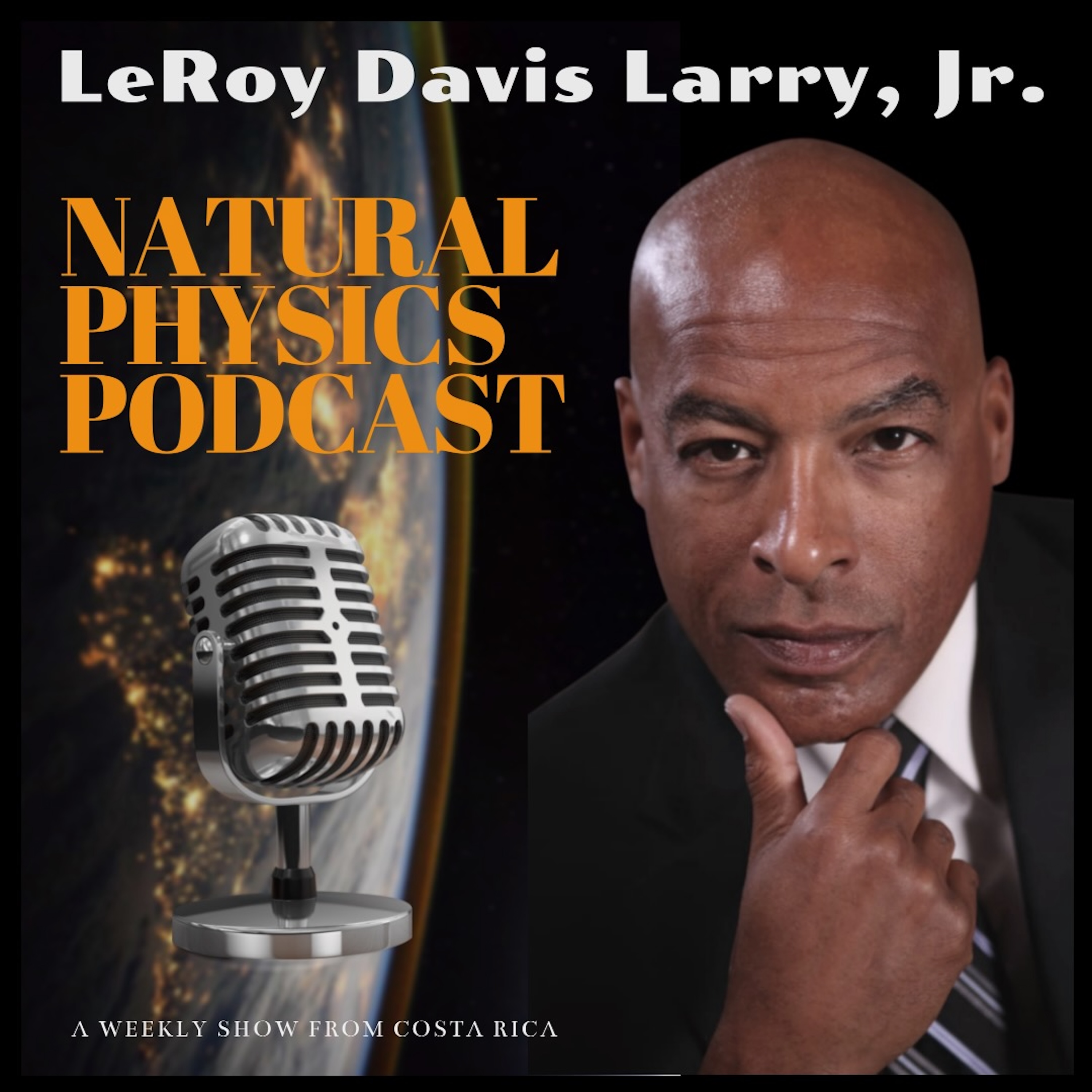
Natural physics is a concept astrophysicist Leroy Larry developed that explains in down-to-earth scenarios how the principles of physics could have come about from observing nature.
Each episode begins with a scenario, followed by an example to illustrate the application of these principles in futuristic research at the frontiers of science, such as Leroy's astrophysics doctoral research at Cinespa Center for Space Research, and then concludes with an exploration of how these same principles could have very well been used by ancient cultures and civilizations.
Mathematics is naturally encountered and incorporated as the exciting and fun tool of science that it is.
Science is the window into our amazing world of nature, and mathematics is the tool to open that window.
Natural physics encompasses current, futuristic, and ancient physics, and ties them together by the principles of physics that are common threads running throughout each.
Natural physics, natural physics, and natural physics, and natural physics, live from Costa Rica.
Happy and safe summer solstice to all of you out there and your families.
My very, very special guest today is August, who you may remember was on the show back in February when we did a combination birthday celebration for both of us,
and to celebrate the return of the comet that hadn't been around for 50,000 years, C2022E3, ZTF.
I want to start the show by us sharing how we each were able to see this once-in-a-lifetime celestial object.
I hope you out there listening and watching, I hope you got out to see it, or at least try to see it,
because think about it, every 50,000 years, right?
I mean, can you even imagine how long ago that is?
50 years ago is a long time ago, right?
10 years ago is a long time ago.
50,000 years.
And it wasn't discovered until 2022, which is part of how it got its name.
So what I want to start off is by showing you some photos that Tirza and I took.
We actually were lucky enough to find an astronomy group here in Costa Rica that organized a field trip, basically.
We took a bus to the volcano Irazu, and we saw the comet from the crater of this volcano.
How cool is that, right?
I mean, that's just unreal, right, to be in a volcano, a crater, and see this 50,000-year-old object.
So we're doing share screen.
We tested it out.
We're going to try it out.
So I'm going to show you my pics, and then we have some pics that August has, too.
So, okay, so what I'm going to do, so I'm going to go down here to my desktop, okay, all right.
Now, I'm going to put up the first picture.
Can everybody see that?
August, can you see that?
Yep.
Yep.
Okay, Ray, we're good to go, right?
All right, all right.
So this is the bus, the little tourist bus that we took to the volcano.
And where we live, the volcano is in Cartago, which is north of here, and it takes about an hour to get there.
But, yeah, they had a bunch of three or four or five tour buses, right?
I had my NASA sweatshirt on, right?
Oh, we were so excited.
Okay.
So now, let's see.
Okay.
There's Tirza, and there's the crater that we were in.
And you can see the astronomy group starting to sit up their equipment, right?
And by what she's wearing, it was chilly, everybody.
This was February the 11th.
Now, when we had our birthday comet show, February the 1st, which was my birthday, that was the comet's closest approach to Earth.
But because we're so close to the equator in Costa Rica, we were able to see it a while longer.
So February the 11th is when this was, right?
Okay.
All right.
There I am.
I'm totally stoked, right?
Didn't quite yet know how cold it was going to get, but right there, it's getting close to sunset.
Yeah, we're still okay.
Okay?
There you go, everybody.
We were so cold.
Oh, it got so cold, and the wind picked up.
And actually, when we signed up for the trip, they had a little paragraph in there that said,
bring warm clothes, gloves, stocking caps, boots, heavy coats, right?
Did we acknowledge that?
No.
We were freezing our patooties off.
Let me tell you, it was so cold.
Oh, my goodness, it was cold.
We're smiling, but we're freezing.
Okay.
There you go.
See, you can see the little, where the telescopes were set up.
And we had our little, we actually, this deal right here, we tried to wrap it around, the tarp that we had to sit on the ground.
We tried to wrap that around us, because the wind picked up.
Oh, it was, but it was worth it, everybody.
I'm telling you, it was, okay, I'm going to come back to us.
Okay.
Okay, I'm going to come back to me.
It was, it was so worth it, everybody.
I mean, it was just, and so check this out.
Okay.
We had bought these pair of binoculars beforehand, heavy duty.
They're 8 by 42.
I mean, it's just like having a telescope.
But see, there it says, let's see.
Okay, it says, all right, come on, Leroy, just get it right.
Swing that way so the people can see.
There, 8 by 42, right?
And they're very powerful.
I mean, and they're so convenient, because a telescope, you're just looking in one eye, right?
And this is both your eyes.
And so we got these binoculars.
So every night, February 1st, I would go outside and see if I could see it.
I saw some cool objects, but couldn't quite pick up the comet.
And that's when we decided we better get with somebody who knows what they're doing, right?
Professional astronomers who can tell us that is the comet.
So everybody, we're up on the volcano, it's after sunset, and they have the telescope set up, right?
So all of a sudden, this beam goes up, and everybody starts applauding because they located the comet, right?
It was very close to Mars, right?
This whole applaud just went up, right?
And the beam, it pinpointed where the, yeah!
It was just, it was so cool, right?
And then we stood in line to look through a telescope that they had it exactly pointed at the comet.
As Tirza liked to say, it looked like one little pinpoint of light next to another pinpoint, right?
Meaning Mars.
But we saw it, right?
And we knew we saw it because we had professional astronomers saying, you're looking at the Green Comets.
ZT, or sorry, C-2022-E3-ZTF.
So, okay.
It was great, everybody.
And we got back home around 11 at night because, again, it was an hour to get to the volcano.
An hour to get to Cortago, then another hour to get to the, or not an hour, but more time to get to the top of the volcano, right?
And then all that to come back home.
So we caught that bus around 3 p.m. in San Jose, and we got back home around 11, 11.30 p.m.
It was great.
Okay, now I'm going to go to the pictures that August has.
And August, if you would, please describe to us what we're looking at, okay?
Okay.
All right.
Okay.
I'm going to minimize this.
And what I'm going to do is, all right, go to my, okay.
All right.
So here's the pictures that were sent to me.
Okay.
Okay.
Go right ahead, August.
Describe this.
So that part is the moon that we actually, we actually went to an observatory to actually look at the moon through a telescope.
And then they're trying to line up the comet with the, with the, with a telescope.
So we were just looking around the others, around some more, and then we saw this picture.
Okay.
You can actually see the craters of, of all the, of the moon.
Yes.
Yeah.
It's just like the group we were with, August, where they had to get their equipment set up and then they kind of had to get their bearings and find, find it, right?
Find the comet.
Okay.
Yeah.
So, and, and, and, and, and here they use Mars, I think is kind of a reference point, but, uh, oh, right on.
Okay.
Okay.
We'll go to the next one.
Is that cool?
Okay.
All right.
Here we go, August.
Okay.
How about this?
I think that's the telescope that was the one that we could actually see the green comet.
I don't actually know exactly which one that one was, but I do know that's one of the telescopes we looked through.
Okay.
Okay.
Okay.
Great.
All right.
Okay.
Wow.
And that.
You had a computer screen.
That right there is actually the green comet.
It's the one.
It's one of the four pictures that they actually took about of the green comet.
And, um, they said it may be showing for a few, for like a few minutes and it'd move.
And then they'd have read, read, read, adjust the, the, um, the telescope.
And yeah.
That is so cool.
You got to actually see the color of it.
See, when, when tears and I went, when we went to the volcano to the top of the volcano, uh, to see it, we, we saw a pinpoint of light, right?
Right next to Mars.
But there's, there's no way we, we could actually see the colors.
So, oh, that's just so cool.
Oh, see, being with professionals, right?
Professional astronomers, like we were, and like y'all were, that's, that's the way to rock and roll.
So, you, you know, you're going to have a chance to see this once in a lifetime object.
Okay.
I'm going to go to the next one.
All right.
Okay.
I see somebody with a stocking cap on, huh?
It was also in the middle of February.
So, we had like our, our, um, it's colder here in Alberta.
So, we actually had to wear our snow pants, our winter jackets, our toques, our mitts.
We basically had to wear everything because it was so cold.
See, y'all were smart.
Unlike two people, I know.
All right on.
And you know what?
They had people up there with us that had come prepared.
I mean, they were, they were just load, loaded up and they were having a great time.
I mean, they were comfortable.
We had a great time too, but we were just so cold, right?
And we would have enjoyed it a whole lot more better if we would have been dressed properly.
So, oh, congratulations to y'all.
Yeah.
Oh, Canada.
Yeah.
I, yeah, I can imagine how cold it was.
February too.
Yeah.
Yeah.
Okay.
Great pictures.
I'm just going to go back the other way.
Just, uh, wow.
That's such a cool picture.
And you remember August, the color of it, the green color of it, it comes from the chemicals
that, uh, make, make it up, make the comet up.
So when the sun burns off parts of the comet because of the, the chemical makeup of it gives
it that, that green color, uh, you might think of chlorophyll, right?
That plants have that give them their green color.
But I don't know if chlorophyll, yeah, chlorophyll is one of those elements, but that's a cool
picture.
That's a very cool picture.
Okay.
Yeah.
Yep.
Telescopes were necessary, even from the top of a volcano.
Cause yeah, we took the binoculars with us, right?
Up to the, up, up there.
And when they, um, when they, when the applause went up and they said that they had located,
uh, they had located the comet, I tried to see if I could see it with the binoculars and
I, I couldn't, I could see Mars really good, but I couldn't see, I couldn't see the comet.
So, um, it was worth it to, to get with that group and, um, and I'm so glad that y'all were
able to see the comet.
Okay.
So back on our birthday comet show, August, you asked me, how did he get his name?
Okay.
And I have a full answer for you.
Okay.
So it's C 2022, the 2022 means that it was discovered last year.
Okay.
And then you have the E3, well, let me get the, the ZTF stands for the Zwicky Transient
Facility, ZTF.
It's an observatory.
That's where the astronomers were located when they discovered, uh, the comet.
Yeah.
Now for the E3 part.
Okay.
Bruce and I have a good friend at JPL who provided us with an explanation of that.
So I'm going to, I'm going to go to my email and I'm going to pull that up so I can read
it.
Uh, let's see.
Okay.
Okay.
Here's, here's what he said.
Comets are designated with nomenclature similar to what's used for asteroids.
So the initial letter indicates the half month of the year in which it was discovered.
Therefore, E means it was discovered in the fifth half month of the year or the first half of
March.
Three means it was the third comet discovered during that half month.
And as I said, ZTF means it was discovered at the Zwicky Transient Facility Observatory, um, which
which that observatory is named after, uh, brilliant and irascible.
Ooh, that's a word.
Fritz Zwicky, one of, one of, uh, one of the most insightful, brilliant astronomers of
the 20th century.
Irascible.
Um, I believe, August, irascible means kind of like, like a rascal, right?
Like you're, uh, uh, in a good way, right?
You're, you know what?
I got the screen up.
Let's just, let's just do this.
Okay.
Rascal.
Rascal.
Okay.
Irascible means having or showing a tendency to be easily angered.
Oh, okay.
Okay.
So, so this person that, um, that the ZTF facility is named after was easily angered.
Okay.
All right.
Okay.
All right, then.
Interesting, huh?
Hey, all kinds of personalities make great discoveries, August.
That, that, that, that's for sure.
Okay, so now we know how the comet got its name and, um, all right.
Okay.
So I wanted to do the comet experience shared with our listeners and viewers, and it's so
cool that, um, you were able to see it in Canada.
We were able to see it here in Costa Rica.
I'm looking out the window.
I just saw a lightning bolt.
The reason why I'm telling everybody this is because it's the rainy season here in Costa
Rica.
Uh, we basically have eight months of rain and four months of dry, right?
And, and, um, and these lightning bolts are, they're, they're pretty strong.
And sometime they hit a power transformer and the electricity goes out.
So everybody listening and viewing, if all of a sudden we go off the air before two o'clock,
you know what happened, right?
We got jammed up by a lightning bolt.
Okay.
Okay.
All right.
Yeah.
Seriously, August.
I mean, it is some serious electrical storms that, that, that, that happened here.
I've never experienced, uh, thunderstorms and lightning storms like this.
It's, it's, it's beautiful, but it's, it, it shows you the power of nature, uh, uh, power
that we have no idea of.
Okay.
Now, August, my understanding is that you had some questions about astrophysics that you
would like to ask me.
So Phil, you have full reign, ask me anything.
I will do my best to answer them.
And if I don't know the answer, I will find the answer and I will get that answer to you.
Does that, does that sound cool?
Yeah.
Okay.
Okie dokie.
Let's roll.
All right.
Let's rock and roll.
Okay.
All right.
The first question is how are galaxies made?
Okay.
Okay.
Now the theory in astrophysics is that there was this event called the big bang, which is
how the universe started.
I'm sure you've heard of it.
Uh, there was this event that occurred where immense amounts of energy were released.
And as the energy proliferated, and you know, I wanted to use that word as the energy proliferated,
as it distributed out in the space, gravity came into the picture and started to pull the
mass together in clumps.
And these clumps were called proto galaxies and then galaxies formed from that.
And then from the galaxies, stellar systems form planets.
Uh, and, and August it's, it's a theory that, um, you wonder if it can ever be proven.
I mean, how are you going to prove that?
I mean, you can't go back into time and get a ringside seat and watch the big bang happen
and watch the galaxies form, right?
You can't do that.
So, okay, physics, August, physics seeks to use mathematical equations to try to describe
the things that we experience in nature.
Okay.
Um, the colors, the colors that you see, there's equations that are in optics, which is the part
of physics that tries to understand light.
How does light work?
Right.
And I know I probably sound now like a broken record.
I know, cause I've said this before, but until somebody comes up with another method to describe
the, the phenomena in nature, mathematical equations are all we have.
That's it, right?
That's it.
And so, um, so in physics, there's equations that try to describe light and sound.
Okay.
Everything we experience in nature, physics tries to come up with the mathematical equation
that, that describes what we observe.
So astrophysics, that's the area of physics, oh, how were galaxies made?
Did you type that in August or does somebody out there type that in?
Oh yeah.
By the way, everybody listening and, and viewing, you can type in questions too.
Okay.
You can totally type them in, right?
Join, join the party.
All right.
Okay.
So again, astrophysics tries to use, uh, mathematical equations to describe objects in outer space,
how the planets move, how comets move, how asteroids move, right?
How black holes, what they do.
And imagine August trying to describe something that you really won't have a chance to get
out and get up close and personal to, right?
Right.
I mean, if you're here on earth, yeah, if you're okay, like, okay, for example, and we're going
to get to this later, right?
One of the basic equations in physics is force is equal to mass times acceleration, right?
So when you, let's say you push a ball, you apply a force to that ball and the force you
apply is equal to your mass times the acceleration that the ball, um, experiences.
Okay.
Or no, that you have, I'm sorry.
Yeah.
The force that you push the ball with is equal to your mass times the acceleration that you
push that ball with.
Right.
So most basic equation in physics, August, um, everything kind of stems from that, that,
that basic equation.
Okay.
Um, but so here on earth, you can do your experiments.
You can say, okay, if I push this with this much effort and it, and, and I have this mass
and I have this acceleration, this is the force.
Okay.
Here's a better one.
Your weight.
When you stand on a scale to get your weight, August, and we're going to get to this later
too.
I hope you're going to enjoy it.
Okay.
Your weight is basically the force that your body, the mass of your body through gravity
exerts on the surface of the earth.
That's what your weight is.
That's what your weight is a force, August, that you apply to the surface of the earth.
So right here on earth, you can do all those experiments and get the right equation.
Weight is equal to mass times gravity, right?
But imagine trying to come up with an equation to describe the, the motion of the moon around
the earth or the earth around the sun or, or the motions of, uh, galaxies through the universe,
right?
Imagine trying to come up with the equations that describe that.
So that's what astrophysics is.
Okay.
And the, the, and we'll get to this later.
The research that I, that I do, that I've done and hope to get back to, uh, tries to figure out
where cosmic rays come from.
Right.
And, uh, and we'll talk about this later, but okay.
I want to make sure we get to your question.
So, okay.
What did that answer your question, August about where galaxies came from?
Okay.
Okay.
All right.
Next.
And also as a astrophysicist, how do you measure the size of a new galaxy?
How do you measure the size of a new galaxy?
My goodness.
That's an excellent question.
Okay.
All right.
Now, the way that distances are measured in outer space.
Thank you, Ray.
All right.
Okay.
Um, instead of using, for example, a mile or a kilometer.
What's used is called a light year.
And it might sound like it's a measurement of time.
Okay.
You're shaking.
So you, okay.
Excellent.
You know what I'm talking about, right?
Um, light year is actually the, the measurement that's used.
Now, light year travels at 186,000 miles per second.
Not per hour per second.
Okay.
A hundred, one, eight, six, zero, zero, zero miles per second.
I mean, when you turn off the light at night, when you go to bed, it seems like light is instant,
right?
It's instantaneous, but no, but, and, and again, to doing what you can do back here on earth,
a physicist was able to devise an experiment that actually determined that light had a velocity.
It didn't have an infinite speed.
It had a certain velocity, famous experiment, famous experiment, August.
Um, and so in kilometers per second, that's 110 kilometers per second.
Okay.
Okay.
So for example, uh, sunlight, sunlight travels at the speed of light at 110 kilometers per second.
So it actually takes a beam of sunlight, eight seconds to go from the sun to the earth.
Okay.
So in other words, when you look at the sun, the light you're seeing, well, never look directly
at the sun, but with your naked eye, but, uh, the light that you're seeing from the sun
actually took eight seconds to get from the sun to earth and the moon, it takes three seconds
for moonlight.
Now you can look at the moon directly.
So when you're looking at the moon at night, think that what you're seeing is actually three seconds
ago.
Pretty cool, huh?
So these galaxies are so huge, August, they're light years across, right?
Um, that's what's used is light, um, to, to measure how long it would take a beam of light
to go from one end of the galaxy to another end of the galaxy.
Um, now I'm not exactly, I'd have to look up the, what's used lasers or, or what, but that's
basically, uh, how the size of galaxies are, are arrived at.
And you know what, uh, August, you've probably seen, I mean, you've probably seen pictures
of galaxies, right?
With, um, the different space telescopes are beautiful, aren't they?
There's a beautiful, okay.
There's some are spy.
Yeah.
Uh, some are spiral, some are, um, round elliptical, right?
Right.
Now the Milky way galaxy, what, what shape do you think it might be?
August spiral, elliptical, round, square.
Square, what, what do you think?
This is kind of a trick question.
Whoa.
Excellent.
Here, I thought it was a trick question.
Well, now everybody, it, the reason why I said it's kind of a trick question is because
think about it, we have never had a spacecraft to leave the Milky way galaxy.
I mean, think about it, Voyager, Pioneer, all the space probes have just been in our solar
system, right?
From the earth to the sun and from the earth out to, uh, Pluto.
Uh, well, Pluto's not called a planet anymore, Neptune, but anyway.
Uh, okay.
And they've taken beautiful pictures.
They've taken beautiful pictures, space telescopes of nebula out in space, right?
The horse head nebula and the crab nebula, just beautiful, right?
All these, hey, black holes, right?
There's actually photographs of a black hole in the, in, in, in, in that, and that's another
thing, August.
Astrophysicists believe that every galaxy has a black hole.
There's a black hole in the middle of it.
And okay.
You know, when you turn on your bathroom, uh, sink or kitchen sink and the water twirls
as it goes down the drain.
Yeah.
Well, it's like, it's like the black hole is your sink and the galaxy is circling around
it.
So that's the theory in astrophysics is that at the center of every galaxy, there's a black
hole that's attracting all this mass, all this matter around planets, stars.
I mean, it's unreal, but again, no one has ever been able to travel out to a black hole and
get up close and personal.
Okay.
Not yet.
And, and the thing of it, August, is that you said that the Milky way galaxy is a spiral
galaxy.
Well, your guess agrees with the current theory in astrophysics is, is that our Milky way galaxy
is spirally shaped.
And the way this is determined is from data sent back from space probes and, and comparing
what we see in other galaxies.
But think about it, August, there had, unlike the space probes that have been able to go to
different planets in our solar system, no space probe has yet been able to go outside of our
Milky way galaxy and turn around and take a selfie.
Right.
Right.
The, the, the, yeah, the space probe goes outside of the galaxy and says, oh, I'm going
to get a selfie of me with the Milky way galaxy behind me.
Click.
Right.
That has not happened.
And, oh, it's, we, so we really don't know what our own galaxy looks like.
That that's the bottom line.
But the theory agrees with what you said, that it's a spiral galaxy.
Okay.
And as I said, the way that the size of galaxies are measured is by using the light year.
And actually, our galaxy is theorized, August, to be about 110 light years across.
So in other words, you multiply 110 by 110,000 kilometers.
And that's what, that's what the theory is about how the size of our galaxy.
I hope I'm not misquote.
Now, 110 light years across, I'm pretty sure that's the right number.
I may be wrong, but, but anyway, that's the light years used.
Okay.
Is that cool?
You good with that answer?
Yeah.
All right.
Next, next question.
Why does a nebula stay together instead of dispersing into space?
Okay.
Gravity, August, gravity.
Gas has a weight, has a mass.
And anything that has a mass is acted on by gravity.
Okay.
The only objects we know in physics that aren't affected by gravity are photons, which back to light and the speed of light.
Astro physics, physics has shown through experimentation that light actually has two, two parts to it.
One, it acts like a wave, like an ocean wave, and the other, it acts like particles.
Okay.
And these particles of light are called photons, and they travel at the speed of light, 110,000 kilometers per second.
Gravity does not act upon photons.
Magnetic fields don't act upon photons.
They're, they're, they're particles of light.
And, and so, so with nebula, they're made out of gas.
And even though it's a very diffuse gas, it still has a mass to it.
And because there's so much of it, gravity acts upon the nebula and keeps it, keeps it pulled together and doesn't keep it floating from out in the space.
And if you don't have any more, that's cool.
Okay.
Okay.
This one was actually supposed to be for the radiologist, but I guess she's not here, so I don't actually get to tell it to her, but I'll ask you the same question.
How is, how does radiology relate to astrophysics?
Oh, what a great question.
Okay.
Yes.
Her, her job as a radiologist.
Yeah.
She's in LA right now doing that.
She'll be there for three weeks, but the equipment that they use, use is, is applied physics, August.
The equipment, like for example, x-ray machines, they use x-rays, right?
And, and, and, and, okay.
Now, photons, the particles of light, they have different energies, August.
Okay.
And you can have different types of photons.
Okay.
You can have radio photons, microwave photons, infrared photons, optical photons, and, and, and the optical range that, that goes from red.
Uh, correct me if I'm wrong, red, orange, yellow, green, blue, and violet, which, okay.
And then you have ultraviolet photons and you have x-ray photons, and then you have gamma ray photons.
Okay.
And, um, now that's called the electromagnetic spectrum.
Uh, the different levels of energy that we know to exist in nature.
And the only part of that spectrum that we can see with our eyes is the optical, which is a very, very small part of the whole electromagnetic spectrum.
So you have these machines that use, that apply physics, right?
Microwave ovens, right?
They use microwaves.
Uh, the x-ray machines use, uh, let me, let me go back.
Um, the microwave ovens use microwave photons to supply the energy, to cook the food, to heat the food.
Ovens, regular ovens use infrared photons, right?
To, to heat, to heat the food.
Um, uh, uh, uh, x-ray machines use x-ray photons to, to, to, to see inside of our bodies and, um, radio, radio, the, the equipment,
the equipment that's used in her radiology office, some of the equipment uses radio wave photons to, to, uh, uh, to observe their patients.
So you see, you see physics is just, uh, being able to apply physics as a benefit to humankind.
That's one of the reasons why I, I've always enjoyed, uh, doing physics and, and, uh, it's, it's, it's just such a, it's such a, a, a science that not only tries to describe what's here on earth through equations, but what's out in outer space too.
And look at the spinoffs, microwave ovens, right?
Radios, ovens, everything.
I mean, x-ray equipment.
Uh, so, um, and yeah, what Tears have told me is that they have specialists that are especially trained to use these, uh, this equipment, but they all use photons, right?
Photons from the electromagnetic spectrum.
Now, August, because I want to make sure we have enough time.
Excellent questions.
If you don't, if, if, if you have more questions, we can get to them.
You can email me or we can have our own little meeting or we'll have another show where I can answer more of your questions, but the video that I'm going to show, it kind of, it, it describes where physics and astrophysics is in terms of understanding our world.
So, and, um, now I have a question for you, August, are you familiar with the comic book character called the Hulk?
You don't know the Hulk, huh?
All right, hold up.
Let me do it.
I'm going to do a, I'm going to do a screen share.
Okay.
And I'm going to bring up a picture of the Hulk real quick.
Okay.
Okay.
Okay.
Yeah, it's like, kind of, oh, okay.
Okay.
See that big green dude?
Yeah.
You know him, right?
Yeah.
The Hulk?
Yeah.
Yeah, yeah, yeah.
Okay.
Yeah, there you go.
That, the Hulk.
Okay.
All right.
Okay.
Now, so, you know, you know the Hulk.
Do you know what made the Hulk, do you know what made the Hulk the Hulk?
Uh, I'm guessing it was a portion.
A what?
A what?
A portion.
A portion?
A potion.
That's what I meant.
Oh, a potion.
Like a magical potion.
Okay.
Not quite.
Actually, it involves physics.
Now, remember how I said there's the different energy photons?
Let's see.
Let's see.
Microwave.
Oh, sorry.
Radio.
Microwave.
Infrared.
And then the optical.
Red.
Orange, green, yellow, blue, violet.
Then ultraviolet.
X-ray and gamma rays.
Where gamma rays are the most powerful form of energy we know of that exists in nature.
Okay.
Um, unbelievable amount of energy that they, that these gamma ray photons contain.
And, uh, the Hulk, he, the scientist that was experimenting with gamma rays, he had an overdose of gamma rays, and it turned him into the Hulk, right?
Okay?
And, and gamma rays, um, the theory is that, the theory in astrophysics is that they're produced from cosmic rays.
Now, cosmic rays are very highly energetic protons and electrons that reach us from somewhere out in the outer space.
And as these highly energetic particles collide with each other, they produce gamma rays.
Okay?
And, and, and the gamma rays reach Earth, and they have such high energies.
And the thing of it is, August, is that we have particle accelerators here on Earth.
These machines that try to accelerate protons and electrons up to very high speeds to try to rep, to try to reproduce that energy that cosmic rays reach Earth with.
But we can't, we don't have the machines yet that can duplicate the energy that the, oh, thank you, Ray.
We, we, we have not been able to make the machine that will be able to produce the energy that these cosmic rays reach us with.
So, part of my research, my astrophysics research, August, is trying to find out where cosmic rays come from.
And, and, and the big candidate are what's called supernova remnants, right?
When a star explodes.
So, we're going to play this quick six-minute video.
And everybody listening and watching, as we go forward with our show, we always want to stay with the current, futuristic, and ancient physics,
and show how they're all tied together by the principles, by the principles, by the principles of, I better take a drink of water here, I'm starting to slur my words.
How, how they're tied together by the equations of physics, the principles of physics.
The basic equation, like F is equal to MA, force is equal to mass times acceleration, is used in futuristic physics, like astrophysics research.
And, I've always thought that ancient peoples, they had their science, they were able to do things that we can't figure out how they did, like the spheres of Costa Rica.
How do you make a totally solid granite piece of rock perfectly spherical, how do you do that?
We can't do that, unless you lose, use a laser or something.
So, Ray, if you would play this video, August, I hope you enjoy.
And, and part of it talks about astrophysics and what I'm doing, and maybe we'll also answer some of your questions.
Okay, Ray, please roll that video.
Oh, okay, brother, down, down, I'm out, I'm down, you won, brother.
Ha ha, got you, little brother.
Yep.
The force, U, is equal to my mass times acceleration.
Ah, is that why you're able to spin, oh, yep, spin me around so fast?
That's right, little brother.
Ah ha, so acceleration, oh yep, that's speed, that's fast, that's rapid, right?
And I, that's right, little brother, and I got a lot of acceleration.
Oh, wow, and that force, that just means because you have a lot of mass, you're a big brother.
You got it, Dini, you got it, little brother.
F equals M, A.
Excellent, brother, and once again, what does that stand for?
Force equals mass times acceleration.
Excellent, very excellent, little brother.
And that's an equation.
Hello there, I'm Asko, Balo's big brother, and Dini's big, big brother.
I'm the original natural physics Sabertooth Titan.
My weight on this toilet seat is equal to my mass times gravity.
And the weight of my tinkle tinkle is equal to its mass times gravity.
Good job, little man.
Good job, little man.
My little brothers talked about how force is equal to mass times acceleration.
Your weight is the force that your mass, through gravity, applies to the earth.
Just like the equation for force is F is equal to M, A.
The equation for weight is W is equal to M, G.
The weight of my plop, plop, fizz, fizz, fizz is equal to its mass times gravity.
Good job, buddy boy.
Good job, little man.
Good job, little man.
Oh, okay.
That wasn't the most graceful dismount, but that'll do, huh, bud?
All right, little man.
Good job.
All right, buddy boy.
Cosmic rays are high energy protons, ions, and electrons that astrophysicists believe are produced
when a star explodes into a supernova as the shock wave from the explosion that spans out in space.
It encounters protons, ions, and electrons.
Its magnetic field pushes them up to very high speeds, and they gain energy by repeatedly crossing the shock.
The most promising sources of galactic cosmic rays are supernova remnants, or SNRs.
They are not only energetically favorable, but also provide a mechanism to accelerate particles to very high energies.
Greetings, I'm Leroy Larry, and welcome to Natural Physics, live from the territory of the Baruchas.
Season 2 opener, rocking and rolling with the spheres.
Hey, baby.
Mwah.
Okay.
Ah, we are disgusting.
We are disgusting.
Good morning, everybody.
I'm Leroy Larry, and welcome.
Join us, everyone, for a full hour as we continue rocking and rolling with the spheres.
Tune in same fat time, same fat channel.
All right.
Did you enjoy that, August?
Yeah.
Excellent.
Excellent.
Yeah, August, every show, we want to do current physics, and then futuristic physics, and then ancient physics.
And forces equal to MA, right?
That was demonstrated by Valodini and Osco.
Okay, in astrophysics, the force that had to be exerted by an exploding star, right, to propel cosmic rays up to such velocities, right?
What immense amount of force.
And then with the spheres, what kind of force was applied to perfectly form these ancient, solid, granite spheres?
And so, it's all connected, and that's what our show is about, and so, okay, we have about four minutes left.
I would like to thank you so much.
You always, this is your second time, you made the show again, just like you did back in February.
And then we're going to continue to do our show, and you know you have an open invitation anytime, okay?
Anytime, August, I mean, and I mean, if you ever want to bring in a guest of your own, you can do that as well, okay?
For sure.
Okay, now, the questions that you asked me today, were they sufficiently answered?
Yeah.
Okay, okay.
Do you have, we have, we have a few minutes, do you have any other questions for me?
And, and, and again, I can, I can answer any other questions you have by email.
Yeah, I can do that, but yeah, do you have any, any more questions?
Not just about astrophysics.
Okay.
What company or agency do the radiologists work at?
Okay, they're in the health field, right?
So, I mean, not only does Tears' radiology office use this kind of equipment, but hospitals, special healthcare centers, oh, they, they all, they all use this equipment, August.
Yeah, I mean, when you think about it, the experimentation that physicists have done gets handed over to the engineers who then make practical applications, like the physicists that discovered microwaves.
Hey, his discovery, the engineers took it and made microwave ovens, same thing with these radiology equipment, right?
They take the results of physics, and they apply it, and they come up with such beneficial equipment for us.
So, organizations, medical organizations, any organization that would be interested in purchasing and operating, and, and, and that equipment is expensive, too.
I mean, it is seriously, woo, it's up there.
I mean, that's some serious, uh, you ever heard that phrase, you break it, you pay for it?
Hey, you can be sure when they're working on their patients, they make sure they don't break anything.
Okay.
All right.
Okay.
So, uh, well, August, I guess we got about a minute left, and, um, do you have anything in closing to say?
Jess, thank you.
Thank you for letting me be on the, the show again.
Oh, thank you, August, for being here, and I think you know, I hope you will be coming back when we have our next show.
I will let you know, and that rhymes.
All right.
Um, Sarah, thank you so much, uh, as always, and thank you so much, and this is just one of the most awesome,
excellent, excellent things I, I get to do through this show, is hang out with August.
All right, everybody, it's two o'clock, we're going to sign off.
As I always say in closing, tune in, next show, same fat time, same fat channel, physics with attitude, okie dokie.
Thank you.