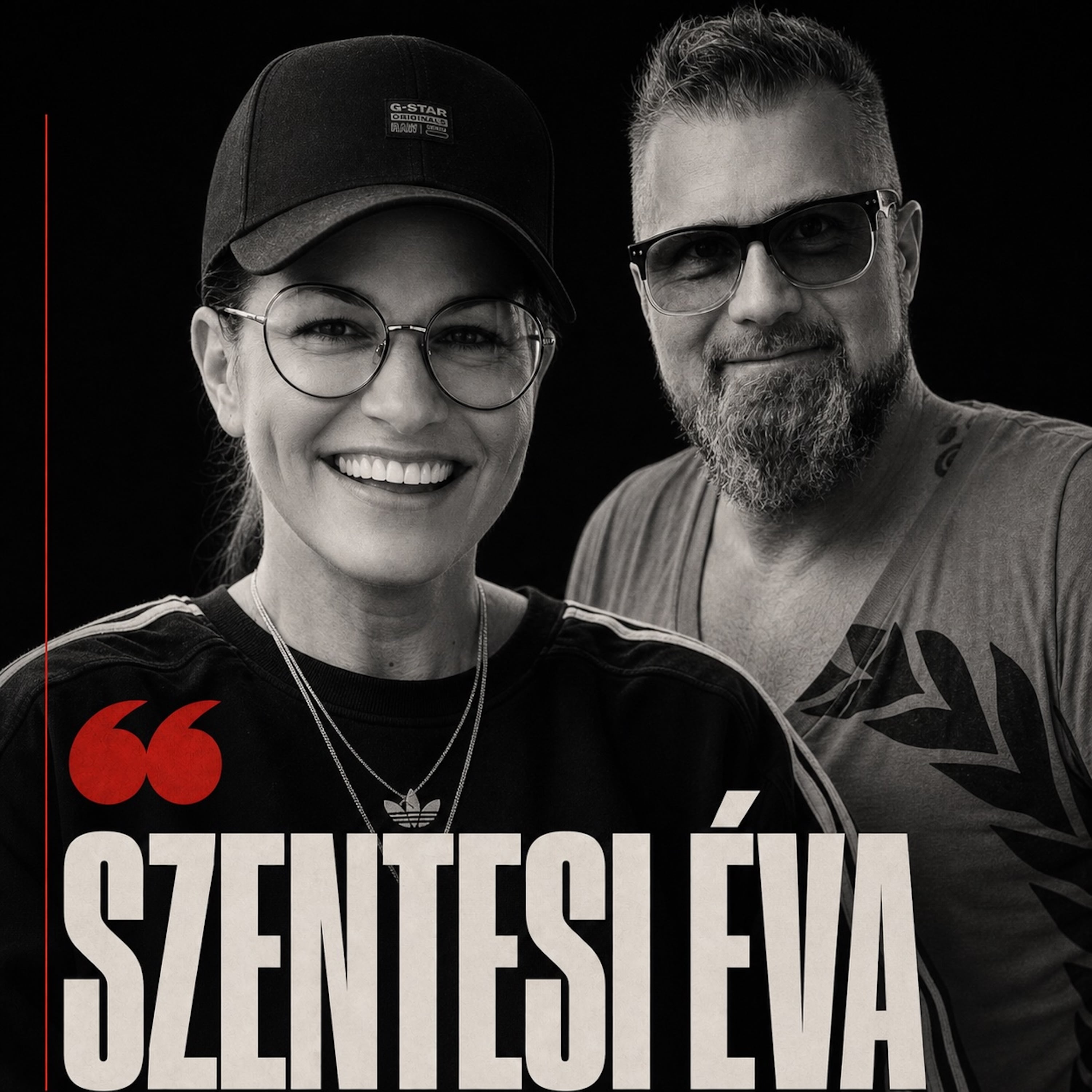
You're listening to an English edition of the Herczeg Podcast, from Budapest FM. In this episode the host, Zoltán Herczeg, sits down with Éva Szentesi, a Hungarian writer and journalist, and a close friend. A gentle note before we begin: this is the most personal conversation in the series, and it touches on serious illness, the loss of a parent, and thoughts of suicide. One narrator will carry both voices, and tell you who is speaking.
Herczeg says at the outset that he wants to go deep, not do the kind of glossy, surface interview he thinks fills the Hungarian media. A person isn't what shows on the surface, he says, but what's underneath, and that's what he wants to reveal. They start light, on what it means to be a writer. Szentesi laughs off the romantic image, the Agatha Christie at her typewriter crumpling pages; the reality is a laptop, and rewriting a manuscript five, six, twenty times over. But Herczeg keeps pressing his real question: not how a book gets made, but how a person becomes a writer.
To answer, she goes back to the beginning, to Tiszalök, the small eastern town she comes from. She drew from the age of three, so obviously gifted that her grandfather traveled to Debrecen to buy her a thick album of painting techniques, willing her toward an artist's life. She won regional and national drawing competitions, and went to art high school in Nyíregyháza to study set and costume design. Along the way, Herczeg notes, she's always been visibly put-together, and that eye for aesthetics was there from the start.
Then the conversation turns to freedom, a thread that runs through the whole hour. Szentesi says she was born free, that from her first moment of self-awareness she wanted to decide for herself and walk her own path. Her parents were a study in contrast: her mother carried a huge longing for freedom, her father set the limits and the rules. And when Éva was fourteen, they divorced. It hit her, she says, like lightning; the children knew nothing, saw no fighting, it was a silent death of the family. That secure childhood world, which she had loved, simply broke apart.
Her first real collision with the world came at the university. She applied to the Fine Arts University for set design, a program that took only a handful of students every two years, and she wasn't admitted. She arrived at the audition at nineteen with bleached, spiked hair and piercings, and, she says, a teacher told her you can't come here looking like that. She heard afterward that her appearance was the reason her portfolio was pushed aside, and it was the same at Kaposvár. It was a deep break, a first taste of gatekeeping, and she reacted by swearing off drawing entirely, refusing to pick up a pencil.
She came to Budapest to try her luck and, because she had to earn money, went into hospitality, four and a half years of it, three at the Déryné restaurant. It was a world away from what she'd trained for, standing behind the bar sometimes sixteen hours a day, but she came to see how much it gave her: endurance, and a gallery of characters from an elite world she'd never have met in Tiszalök. And it was during those years that she began, quietly, to write, encouraged by people around her, Herczeg among them, who kept telling her there was more in her.
The first piece was born on a train home to Tiszalök, passing Tokaj, where she could see, from the tracks, the vineyard that had been her late grandfather's, a man who had shaped her and who died the year she got into art school. A feeling rose up that she simply had to write down. She posted it to Facebook, and it landed; some readers didn't believe she'd written it herself. The posts became regular, then a blog, then, five years later in 2016, a first book, drawn from the hardest material of all: her cancer. She'd started keeping a diary from the day of her diagnosis, written plainly, laid raw on the table, and it reached a very wide audience.
She doesn't want to dwell on the illness itself; she feels it's been talked to exhaustion. What she and Herczeg circle instead is the question underneath it: the stress, and more precisely the anger, that she believes built in her body for decades. Anger at her mother, then her father, over the divorce and the childhood it took; grief piled on grief when her grandfather died that same period; then anger at the art teachers, at the profession, at not knowing what she'd become, at the whole world, everyone except herself, the one person she never sat down with. The last thing she was angry at, she says, was God. And after she buried her mother, just two months before this conversation, that anger finally evaporated.
Faith comes up carefully. She was raised without religion, though her grandmother taught her bedtime prayers, and as a child she loved the Bible stories. When her grandfather died, a good man who'd worked all his life as a paramedic, she decided God couldn't exist. She doesn't hold to that now. What she believes in, she says, is partly herself, her own power to heal, to grow, to love, but also in something larger: the sheer impossibility that a speck of matter in the universe could become consciousness, could become a thought that creates. Whatever makes that work, she calls God, and life itself, she says, is God. Herczeg tells her that, stripped of the man on a cloud with a pitchfork, this is more or less exactly what he believes too.
Then she tells the healing story, and it's the heart of the episode. She never once asked God to save her, not even at her worst. Alone in the hospital for a week, her treatments halted because she was bleeding, in a terrible state at thirty, she let go. If I have to die, she thought, then I will, and so what. And the fear simply left her. She felt light, serene, free, and, she says, she felt the tumor leaving, felt something very bad depart. She did it, Herczeg says, with her own mind, with acceptance, the thing a mutual friend, dying of cancer, could never manage because he clung to the end to the belief he'd recover. Letting go of fear, she says, let love and acceptance flow in, and that is what heals.
Surviving, it turned out, was harder than dying would have been, and that is where the public anger came from. Back in life, she sometimes felt it would have been easier to hear the diagnosis was still terminal than to carry the weight of having lived. There were suicidal thoughts; there was a night screaming in her car, calling a friend to ask how you're supposed to keep living. When her mother developed cancer too and Éva had to return to the same hospitals, she broke down, and realized none of it had been processed. She began serious therapy, and the work was to rebuild her identity away from the cancer, she is not the sick girl people love for having survived, but Éva Szentesi, who writes well and is funny and is simply herself. And the deepest turn was learning to love that self, in all its versions, before asking anyone else to.
The conversation closes on hate, and on love as the answer. What she can't stand about the country, she says, is that people aren't left free to decide whom to love, whether and when to have children, how to live, and that hatred is stoked from above, campaign after campaign, until people suffocate in it. But, she and Herczeg agree, a government can run a hate campaign; it cannot make you hate. Nobody can order her to hate Soros, or Juncker, or even Orbán; she'll look at what someone actually did and judge for herself, and mostly she doesn't want to hate anyone. When a stranger attacks her online for wearing a pink shirt, she can answer: thank you for introducing yourself, have a lovely day, and the hatred simply slides off. Even militant feminism, she says, comes down to the same thing: a man and a woman respecting, valuing, lifting each other, and then there's nothing left to fight about, because the only right any of us truly has, and needs, is the right to love. The good world, they end up agreeing, won't come from any leader; it comes from us. Now there are two of us building it, Herczeg says. Now three. And maybe, if people watch this, many more.