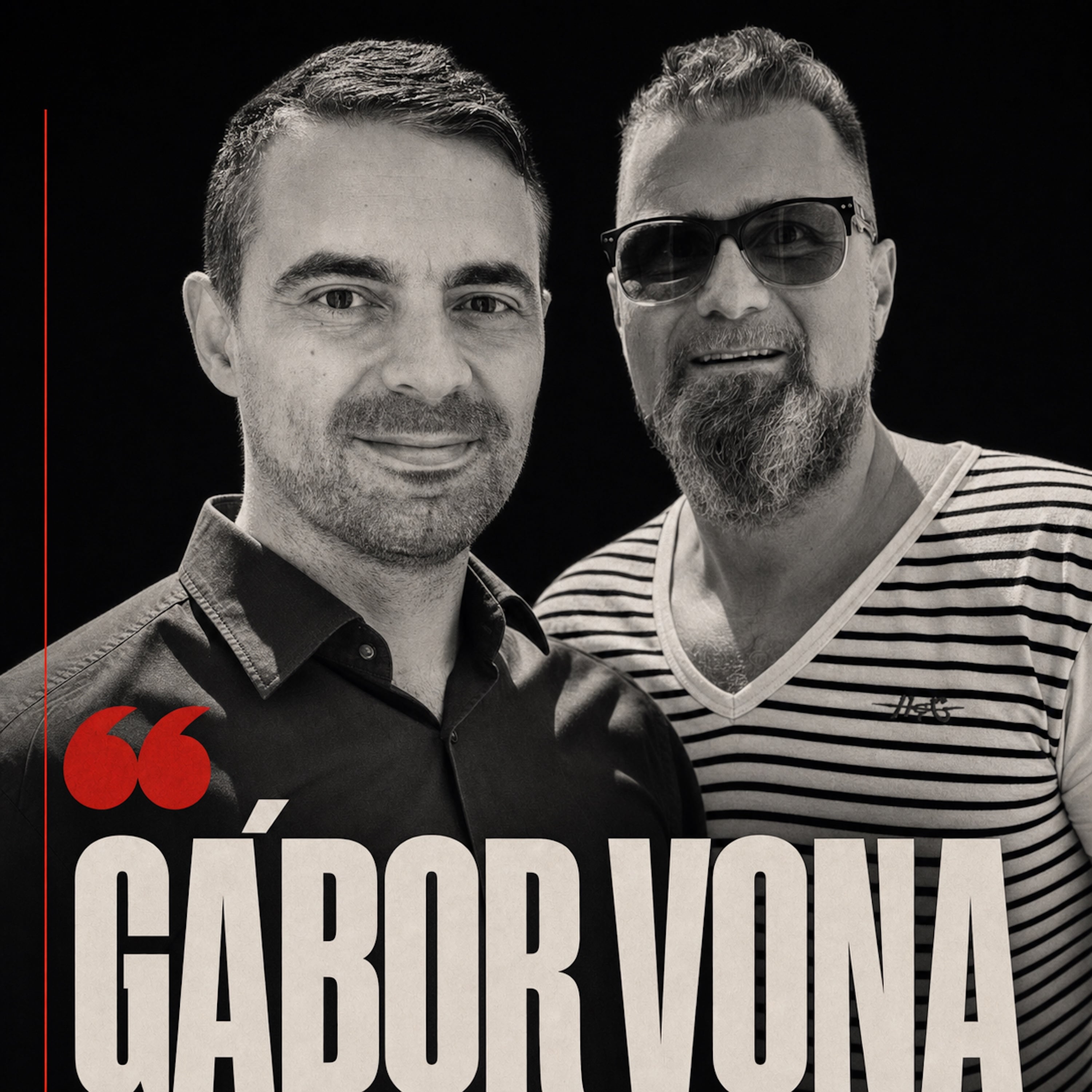
You're listening to an English edition of the Herczeg Podcast, from Budapest FM. In this episode the host, Zoltán Herczeg, sits down with Gábor Vona, the man who for twelve years led Jobbik, once Hungary's strongest opposition party, and in its early years its most notorious far-right one. The two come from opposite worlds. Herczeg calls himself a liberal who, only a few years ago, could not have imagined a friendly conversation with Vona. And yet here they are. What follows is a conversation about how a person changes: how someone becomes a politician, rises to lead the largest opposition party, and then walks away from all of it to become an ordinary citizen again. One narrator will carry both voices, and tell you who is speaking.
Herczeg begins by recalling how they met. Around 2017 they crossed paths online. He had posted an open letter on Facebook, and Vona, then leader of Hungary's largest opposition party, actually replied. You should know, Herczeg tells him, that you were the first serious politician who ever answered one of my open letters. From Orbán on down, I wrote to everyone, and nobody had the courage or took the trouble to answer. You were the first, and it impressed me. He admits he was a skeptic. He was never a right-wing guy, never a conservative, and he could not identify at all with the Jobbik of those years, a party he saw as far-right and extreme. And yet, out of that correspondence, a respectful and genuinely interesting relationship grew, between two people who on paper hold opposite worldviews.
That is the puzzle Herczeg wants to open up: how is it that a liberal who couldn't picture sitting down with Vona now warmly invites him in, and enjoys it? Vona's answer is that they were never as far apart as they believed. Very often, he says, we think we are miles apart, but only because we never actually speak to each other. When a person finds their innermost human quality, he argues, at that level we are all the same. The trouble is that we divide ourselves using categories we didn't even invent, categories politics creates, and then we get tangled in these artificial fault lines. Yes, one is liberal and the other conservative, and on many questions they disagree, but they could name just as many where they quietly agree, and always did.
Herczeg picks up on a phrase Vona used, that they are now equal partners. Why weren't we before, he asks. Notice how even you, without realizing it, place the politician and politics on a higher level, and imply that the ordinary citizen stands below. That is a bad reflex in us, one that politics exploits. It sprawls out above you and starts to rule your life, and you feel that's fine, when it isn't. So he asks Vona directly: when you were a politician, the leader of the opposition, what is that intoxicating feeling that keeps a politician trapped in these categories? A minister is a servant; a politician should serve. So what is this drug called power, and how did you cope with it?
Vona says Herczeg has already named the answer: power. Because we all live believing politics is above us. So when you suddenly enter that privileged circle, become a politician, and, God forbid, actually make it into parliament, yesterday you were an ordinary person, and now the guard salutes you. The guards even have to learn to recognize members of parliament by their faces. Imagine anyone thrown into that. Without a solid self-image, without self-criticism, without the ability to watch yourself, it becomes a terrifyingly powerful drug. Not marijuana, he says, the strongest drug there is, because what we all secretly crave is some kind of immortality, and there you feel like an earthly god.
He is careful not to claim he handled it perfectly. He won't play the man who says everyone else got corrupted but not me. Probably, he says, I didn't always manage it well either. At most I'm one of those who recognized what we were up against. And the first step to healing is admitting you're sick. It may sound strange, but being a politician is an illness in that sense, or at least an opportunity to fall ill. Because you're handed power, and power, like money, corrupts the person it falls on if they have no self-reflection to steady them.
So why go into politics at all? Herczeg presses the point. There must be people who run for the right reasons, to fix the drainage, to run the school lunches better, to actually help the three thousand people in their town. Why is there no room for that kind of politician? Vona agrees the honest motive exists, and says he saw it clearly at the local level. His conclusion is radical: he would ban party politics from municipal government entirely. Not discourage it, ban it. At the local level, he argues, the people who should govern are the local citizens, the ones who can't hide in parliament, who have to walk the market every day and look their neighbors in the eye, and get instant feedback on whether they're doing the job. Party logos, he says, act as a filter that selects the wrong people, loyal to whoever handed them the position rather than to the town.
Herczeg notes that Vona lived inside that system for a long time, and asks how long. Nearly twenty years, Vona says. He started in Fidesz as a university student around 2001, helped found Jobbik in 2003, and led it as president for twelve years, at the head of the country's strongest opposition party. So he saw the story from the inside, and now sees it from the outside, and it's since he stepped outside that the two of them have found common ground. Both of them, it turns out, put the same idea at the very top of their reform proposals: getting party politics out of local government. Vona mentions his foundation, the Second Reform Era, which drafts actual legislation. They've written six or seven bills. And despite all his contacts as a former party leader, he says, he could not get a single one of them submitted to parliament by any party. He suspects it's precisely the laws that would genuinely serve ordinary Hungarians that no one wants to touch.
Can politics be different, Herczeg asks. Vona's answer is blunt, and he calls it his most unpopular idea: not really, not until society itself is different. He finds it cheap, he says, to just point at the politicians and call them corrupt. Politicians reflect what Hungarian society is at this moment. We deserve this. Not less, but not more either. That is our level. And the reason he is now a civilian is that he believes the task right now is to create the demand, not the supply. There is no shortage of good ideas, good programs, good civil groups. What's missing is the demand. Hungarian society, he says, is frustrated and wounded, carrying both a father complex and a mother complex: it wants a leader who rules over it and lifts responsibility off its shoulders, and also one who loves it, praises it, and makes it feel safe. Whoever can play both roles becomes the successful politician here. That, he says, is manipulation, and to change it we have to grow up. We have to become citizens.
And a citizen, he says, is someone independent, who says: I'll hear your view, and yours, and yours, and then I'll decide for myself which one I identify with, if any. In Hungary there is almost none of that. Your vote, Vona says, is your future. Four years of your life you hand to someone. That's a lot. And handing it over should create a service relationship, one where you keep the right to hold them accountable and to criticize. What horrifies him isn't that it's easy to criticize the other party. It's that a Fidesz voter attacking the socialists, or the reverse, gets us nowhere. What we'd actually need is for people to hold their own side accountable, to write the open letter to their own party for once.
The conversation turns to Vona's exit. He left Jobbik in 2018, when it was the strongest opposition party, at twenty percent, with his own party begging him to stay. To this day some can't digest that he walked away. He left, he says, because what he felt and thought inside could no longer be represented honestly within party walls. Herczeg says this is the moment he started to believe him: Vona had promised to resign if the party didn't win, and he kept his word, even though he believes the count that night was rigged. For Herczeg, that kept promise is what made Vona credible, a man the dirty system spat back out. Vona notes the irony that he's in the minority here: many accused him not of courage but of abandoning a sinking ship and betraying the people. Whatever you do, he says, one side will attack you for it.
So what actually changed him? Vona keeps returning to one answer: personal encounters. In parliament, as the far-right faction leader, he was forced to argue with, sit near, and talk to people he'd otherwise never have met. Outside, you can seal yourself inside your own subculture, your bubble, where no outside information unsettles you. But inside parliament, András Schiffer might be sitting next to you. Vona always highlights him. Not that Schiffer changed him single-handedly, but he played a part, and here's why: Schiffer actually spoke to him, while everyone else treated the Jobbik people as fascists not worth a word. Schiffer came over during a break and started a conversation, and was often shushed by his own side for it. He was curious. And you disarm someone, Vona says, in the noble sense, by paying attention to them. Attention is the most sacred kind of influence. You go home, and you find you can't quite hate the man anymore, and after a while you think, fine, then I'll keep walking this road.
Herczeg asks what that was like as the leader of a movement of thousands. Vona describes it as the hardest part. Around 2012 or 2013 he already felt it couldn't go on this way. Picture it, he says: you wake up as the president of a party, a tribal chief, and you realize this is no longer my tribe. He remembers standing at a Jobbik event, singing the anthem, a decent, hard-line national kid beside him, and thinking, do we still belong together? The boy looks to me to show the way, and I'm no longer sure the way I'd show is one he'd like. He saw three options. One: swallow it and keep playing the radical Jobbik president, which he says leads to a split self and mental breakdown, though also to a secure livelihood, and in politics those two often travel together. Two: quit outright and say, we have nothing to do with each other. Three, the one he chose: try to convince his own party to come with him, onto the path he called becoming a people's party. That meant sitting in meetings with sullen loyalists and persuading them, and it worked with some, not with others; some left, some waited, some began sharpening the knife.
From there Vona describes leaving behind the fear at the core of that old identity. A far-right person, he says, isn't secure in his own identity, isn't sure that being Hungarian is a good thing, and so lives in a permanent state of feeling under attack. He no longer believes anyone is secretly plotting to erase Hungarians from the earth. Great powers pursue their interests, the Russians, the Americans, the Chinese, the bigger the country the harder it pushes, but there is no grand committee deciding to wipe out the Hungarians. He suspects Orbán genuinely experiences himself as a second János Hunyadi, a crusader defending Hungary from Brussels and from migrants, and that this is essentially the Soros-plan story that has dominated Hungarian public life since 2015. What actually pulled Vona out of that closed box, he says again, was openness, the willingness to be unsettled by a real conversation and to go home and rethink his life, and be glad he grew a little.
Near the end they reach identity itself. Vona says he's writing a book on this. There is such a thing as being Hungarian, he says, just not by blood. He describes Hungarians sending off DNA tests and discovering they're an astonishing cocktail, a third African ancestry here, roots in Finland or across the world there. If everyone ran that test, he says, they'd realize we are one; and not just the ten million Hungarians, but the eight billion people on Earth. Hungarianness, for him, is a cultural mission: we are the westernmost of the Eastern peoples and the easternmost of the Western ones, a bridge. He points back to the very start of Hungarian history, to Koppány and Saint Stephen turning on each other, each right from his own side, a founding fracture. Right now, he says, we take the worst from both directions, the empty consumerism and cutthroat competition of the West, the despotism and domineering mentality of the East. What if instead we took the East's harmony with the world and the West's innovation and creativity, and made a synthesis of the two? That, he says, could be the Hungarian identity: the meeting of those two halves.
Herczeg calls it an outstanding project, and says he'll be a partner in it, hoping Vona will be his in return, as these many small cells of people sit down together, find common values, find a common voice, and build this Hungary, and this world, together. A wonderful closing line, Herczeg says. Thank you for being here. Thank you too, Zoli, Vona answers. And they end where a conversation between opposites, improbably, arrived: Namaste.