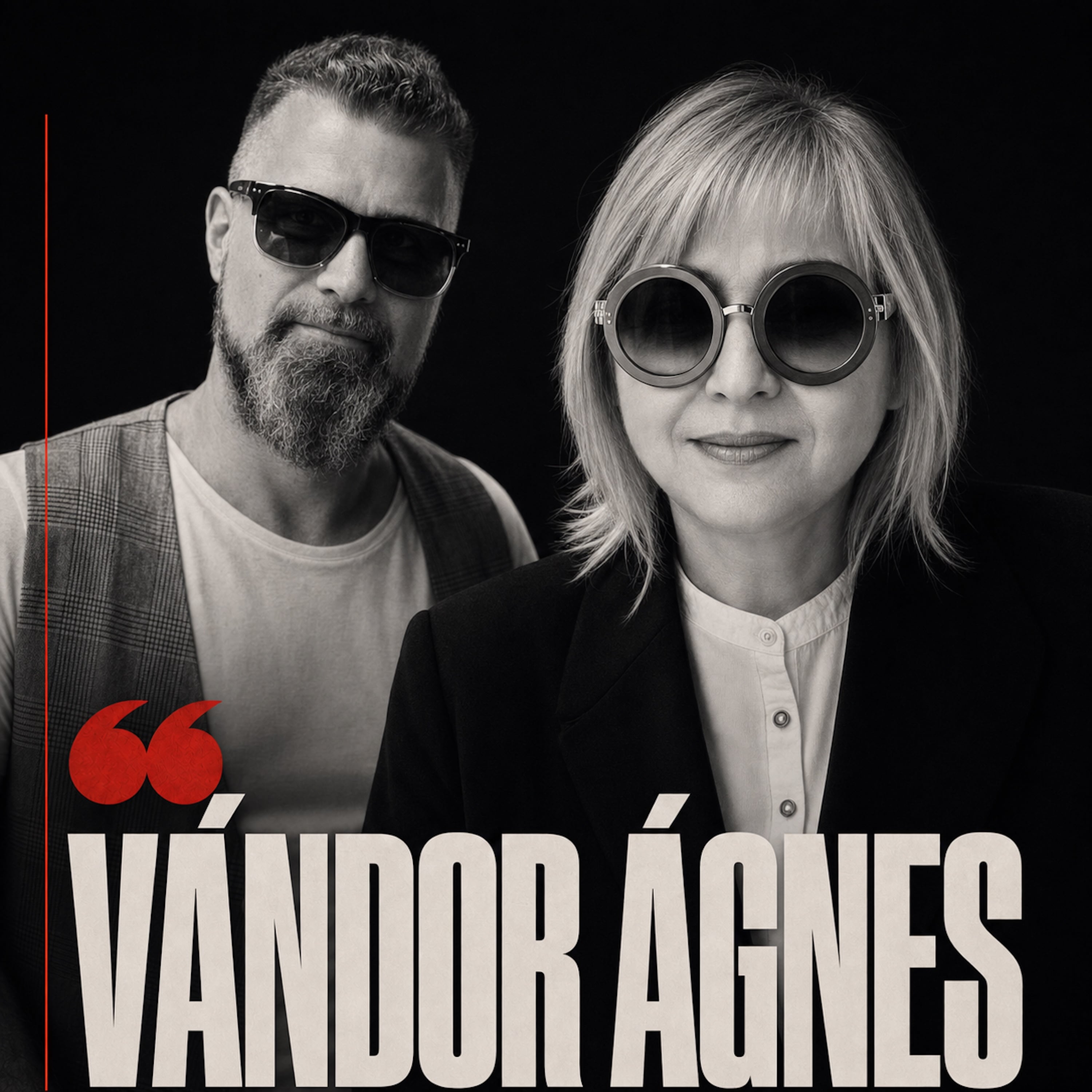
You're listening to an English edition of the Herczeg Podcast, from Budapest FM. In this episode the host, Zoltán Herczeg, sits down with Ágnes Vándor, a former investigative journalist and book publisher who, later in life, went through what she calls a spiritual awakening. It's the most personal and philosophical conversation in the series, so a note before we begin: the spiritual and political views expressed here are the guest's and the host's own, related faithfully, not presented as fact. One narrator will carry both voices, and tell you who is speaking.
Herczeg opens on a familiar theme: the supposed divide between rural and urban Hungary, between the plain-spoken provinces and the Budapest intellectual elite. He came up from the countryside; he'd assumed people like Vándor and her husband, the writer András Réz, were born into a kind of effortless Budapest sophistication. Vándor calls that divide a false one. Réz himself, she notes, grew up largely in the countryside and carries none of the aloof, aristocratic air of the intellectual set. What matters, she says, is understanding the other person rather than labeling them. The moment you file someone into a box, you've built a barrier that makes real conversation impossible. And the images we form from a distance, from the media, from Facebook, are almost always false, because on Facebook everyone is playing a role.
Then Herczeg presses the real question: who is Ágnes Vándor, and where does her calm, warm presence come from? She hesitates, because she rarely speaks about this publicly. For ten years, she says, she has been on a path of self-inquiry, searching for exactly that answer. And then she tells the story. On the night of April 19th, 2011, at the age of sixty, in a single moment, she was, in her words, reborn. Up to one minute before two in the morning she was an atheist, an investigative Budapest intellectual. A second later she was a believer. She doesn't fully claim to explain it; she calls it grace.
The change was total and physical. Overnight she stopped smoking, after buying five boxes of cigarillos the day before; she couldn't look at them again. She stopped drinking the Calvados she'd loved. A publisher who read two or three books a day, she suddenly found she could no longer read literature at all; stories had gone flat for her. In exchange, she says, she was given music. She began going to concerts three or four times a week, like medicine. At her first Wagner, her husband joked she'd walk out in five minutes; instead she sat frozen in her seat until eleven at night, through Parsifal, feeling she might die of the beauty.
She describes three realizations that came to her that night, and asks anyone who'll only be scandalized to simply stop listening, because these are things she once could only have discussed in a psychiatric ward. The first: that God exists. Not that she believed it, she says, but that she knew it, and she pinched herself to remember the certainty. The second, and she knows how it sounds from an atheist's mouth: that she herself is God, and so are you, and so is everyone; taken as personal specialness it would be arrogance and blasphemy, but she means it as a shared divinity, that we are all one. And the third: that everything is exactly as it should be. Behind it all, she says, lies boundless peace, and the closest word for it is love.
She frames it through the work of Stanislav Grof, the transpersonal psychiatrist who studied what he called spiritual emergency, the crisis his own wife passed through. Looking back, Vándor says she went through a spiritual emergency and came out the other side. Here Herczeg reveals his own parallel: he reached the same three realizations, in the same order, through ayahuasca ceremonies, a completely different road to the same place. Both of them, he admits, are usually afraid to say any of this out loud, sure that most people will think them mad.
They talk about the trap that follows the awakening: spiritual ego. At first, Vándor says, you mistake yourself for the chosen one, the new messiah, the only God, and Herczeg confesses he did exactly the same. It's as dangerous, she says, as ordinary ego, just as much a barrier to real freedom, and it's precisely what the spiritual-influencer scene never admits, because they're selling their own path. What pulled them both back was the same lesson: becoming one among many. She loved the ashram in Rishikesh, but you can't live permanently in that state of grace; the real work is bringing it back into daily life, walking down Ráday Street, going in to work, colliding with actual people. That, she says, is where it counts, and where she constantly stumbles.
Which leads them to Facebook, where they both post, and both get burned. Their intentions are good, Herczeg says: he wants to shine a light on some absurdity, some injustice, hoping things could be fairer. But the post itself comes out as a complaint, a burst of negative energy, and if he writes instead let's just love each other, three people react. Vándor knows the feeling. The harder question is the one underneath: how do you know your own view is the right one, and not the person cursing you from the other side? She thinks it over each time, tries not to shout back, but still holds, from an inner conviction, that, say, theft is not work. That conviction, she says, comes from within, from the part of us that is one and the same, that knows what's true for us.
From there the conversation turns to COVID, which, they note, is happening right now with no perspective yet. Vándor, from what she calls her spiritual vantage, says she knew a global sign would come, one that shows that things cannot continue as they are, even to people locked inside their own skins, their own daily suffering, who only know what the media feeds them. The great danger in all of it, she says, is fear, which she treats not in the small sense of being afraid of a dog but as the very opposite of love and understanding, the instrument that cuts us off from reality, and reality, for her, is that boundless peace and love that is the medium of our existence.
Then comes the disagreement that gives the episode its charge. Herczeg asks: will the light really win? Vándor says yes, without hesitation; she believes this whole ordeal exists so the light can win, because in the end only the light is. Herczeg isn't so sure. Looking at the world realistically, he sees eight billion people he half-jokingly calls locusts, the real virus, consuming and polluting at a pace that, he fears, could destroy humanity within a few centuries, leaving perhaps a small remnant to begin again after a Mad Max world. Vándor's answer is that the spark that separates a human from an animal, the divine seed, is exactly what lets us see the person in the other, and that more and more communities and teachings are turning that seed toward peace rather than division.
The most earthbound stretch is about money and injustice, and here Herczeg is raw. He reads that a minister's wife pulled three hundred million forints in profit from a company barely a year old, while he, an internationally known designer of twenty-five years, hasn't earned that in a quarter century of real work. It dissolves his morning calm, he says, and makes him wonder if he's the loser for doing it honestly. Vándor tells him money is just energy that serves you once it's in its right place, but the deeper point she makes is that in Hungary today you largely cannot get rich from performance; the trend runs the other way. If you rage that he has millions and you don't, she warns, you've accepted money as the measure of justice, which it isn't. She has raised her own son, a moral philosopher, she says, not just by talking but by example: money matters, and doing things honestly, on merit, in a world full of privilege, is very hard.
Both of them are wary of where they're stepping, and both name it anyway. Vándor describes COVID, in part, as being about control; her husband calls it a global obedience test. She resents that you need a certificate to prove you're healthy for a concert, and won't enter a system that demands it. It's important to say plainly that this is her opinion, and a contested one, offered here as part of an honest conversation, not as public-health guidance. Herczeg, for his part, says that whenever people genuinely push back, power retreats, but mostly they don't push back, and instead applaud being managed.
They end where the whole series keeps arriving. For all the darkness, Vándor says, there is hope, only hope, and a chance. Herczeg agrees Hungary is an incredible country, an incredible people, and that whenever he leaves for two weeks he races back. The task, they say, is to climb out of the terrible closedness and division, to stop seeing the other as a label, a party, a side, vaccinated or not, and to see the person again. That, Herczeg says, is why he loves talking with Ágnes Vándor, and why he invited her: to say out loud the things that mostly go unsaid. Thank you for being here, he tells her. Thank you, she answers. And that is where they leave it.