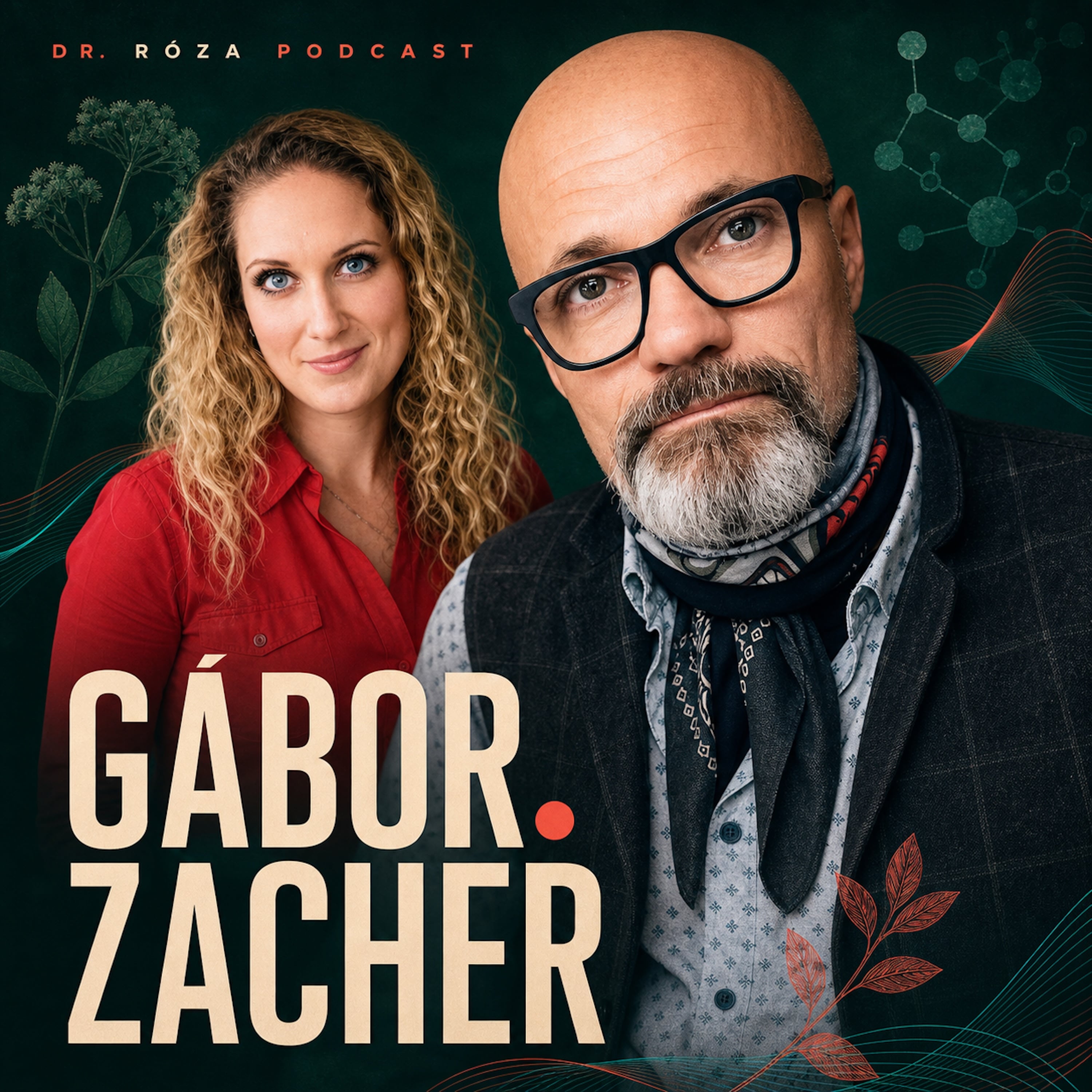
Roza OrsolyaWarm welcome to everyone, I'm Dr. Orsolya Roza, and it is with great joy that I welcome Dr. Gábor Zacher here today, who is perhaps not an exaggeration to say Hungary's best known and most well-liked doctor, thanks to his very high level of professional knowledge, his humor, his great style, direct, honest, and on top of that we can encounter him in so many places, since his work extends to so many things. We don't only run into him as a doctor, we can also take two of his books off the bookshelf, or if we turn on the radio we can hear him mentioned in certain songs, or he gives professional training courses. He was personally my teacher at the pharmacy faculty, where I later found out even humanities students attended, precisely because Dr. Zacher was giving the lecture. And not long ago I even saw him take part in an improvisational theater performance at the Valley of Arts festival, so thank you very much for joining me today.
Zacher GáborWith pleasure, dear Orsolya. Well, let's dive in, because you've said so many nice things so far that now I have to dig up something bad about myself, so as not to disappoint our dear listeners, because you really spoke only in superlatives, I nearly sank into the floor.
Roza OrsolyaThank you.
Zacher GáborWell, really, there's nothing to thank.
Roza OrsolyaBefore we dive a bit deeper into the profession, I have a question that has always intrigued me: what is it that shaped you, that made Gábor Zacher into Gábor Zacher? I'm thinking here of mentors, role models, but this could even be someone from the 18th century, or someone from the family, or a colleague. So if you had to name, say, three people, would there be someone from your life who influenced who you became, or was it more a series of small events?
Zacher GáborBasically, I come from a fifth-generation family of doctors, so for us, for the boys, it was completely natural that everyone became a doctor. This has now broken off both with my older brother and with me, since neither of my brother's sons became a doctor, nor did my son. I have to say, fortunately. If you think about it, when my son was little, what did he see? Well, dad has to go into the hospital, dad is on call, dad gets called in, he gets up at two in the morning, gets in the car because something happened, goes in, etc., etc. Now I think that's not much of a prize for a young person, to live his life that way, so he became a structural engineer instead. I think he made a great decision with that whole thing. So for me, becoming a doctor was simply natural. There were deviations, for about eight to ten seconds, when I thought, I don't know, policeman, firefighter, and so on and so on, but none of these were ever really a serious thing, so I became a doctor. I saw and learned a lot of things from my father, his love of work, and it was interesting to notice that when he stopped working, because my brother and I had already been worried about him, since he wasn't young anymore and was making mistakes, etc., etc., within half a year he died. And he died in such a way that there was actually nothing wrong with him at all. So it wasn't that he had, I don't know, a tumor, or had a heart attack, or anything like that, but he worked and worked, and then afterward, when that stopped, when they pulled out from under his feet that very, very important support that his entire life was built on, he lost the essence of his story, and he simply lay down in bed, and he just looked out from his little head there, and within half a year he died. And I think it's a terribly important thing that a person should work as long as they can, as long as they have the opportunity, and of course should assess their own limits. And that's why I'm very, very surprised by those who, at 70 or 75 years old, are still holding a scalpel in their hands. That's no longer their job. Their job should be to deal with young people, to teach them, and so on. And I think a person really needs to see these limits and respect them. So coming back to role models, that was my father, from whom I learned that a person should try to do something useful until the very last moment, but should know their own limits. Professor Zoltán Záborszky was my first boss at the Military Hospital, ZZ, who was an incredible figure, an absolutely fantastic trauma surgeon, a fantastic human being, I learned a huge amount from him, not just professionally but as a person too. And someone else who meant a great deal to me was János Kiszel. You surely don't remember János Kiszel, but perhaps you remember his daughter, Tünde Kiszel. Well, János was the one who essentially created Hungarian premature infant care. He worked at the early intensive care unit of Gynecology Clinic Number One. When I didn't get into university, I worked there for two years, basically in a fetch-and-carry, gofer role, so I transported the dead, went to pay my bills, went shopping, cleaned the incubators, that sort of story, and there, for example, I saw that kind of determination in János. This was in '78, when I graduated from secondary school, when we really tried, with those tiny beer-bottle-sized little babies, and the technical possibilities back then were very, very different, to, so to speak, shape a human being, so that they wouldn't turn out as some blind, brain-damaged wreck, if they even survived that story, but would actually live their lives. And it was an incredibly important thing to witness that kind of persistence with which they worked there, building the first premature infant ventilator that didn't exist in Hungary, together with engineer Hablaczi. Tivadar Tulassay worked there too, who later was the university's rector for quite a long time. Then there was Pisti Mártai, who later became a pediatrician, spent long years in America as a resident doctor, and now in his old age has come home too. And Tamás Mahai, who was also a university professor at the Pediatrics Clinic Number One. They were all young there, relatively young, this was in '78, quite a few years ago, young doctors, and I learned a tremendous amount from them. And not about the profession, mind you, because pediatrics, premature infant care, I'll be honest, never interested me, but about the human side of their approach. So perhaps those are the people I could list.
Roza OrsolyaWell yes, then you really did grow up among great people, so to speak. And going back to your father, are you able to keep those limits, are you able to set boundaries for yourself?
Zacher GáborWell look, I just turned sixty a few days ago, and I don't feel particularly old at sixty.
Roza OrsolyaWell, you don't look it either.
Zacher GáborAh, say that again! Although sixty years, that's not nothing in a person's life, but I had an incredibly good birthday, my wife created a fantastic surprise for it, and I have to say I still don't feel that I should retire from work. I work for the ambulance service as a responding paramedic-doctor, I crawl under trains, I crawl into collapsed buildings, so for now it still works. Sure, sometimes something hurts here or there, but when the adrenaline rush comes, it doesn't. At sixty I work in the emergency department, and there too I do basically everything: teaching, lectures, forensic expert work, so I stand on quite a few legs, so to speak. I still feel that I'm able to perform. But I think that the moment I really get to the point where, say, the guys have to help me out of the ambulance, then a person has to be able to say, alright, I need to hang this up on the hook now, and I can still go and, say, teach medical students, paramedic officer trainees, because you pass on your experience. So don't be jealous of your own knowledge, because I think that's what teaching is about, you have to pass it on, and you shouldn't see the other person as competition, but rather as a kind of successor. But like I said, I still don't feel that the moment of retirement has arrived. I feel good in my own skin.
Roza OrsolyaWe're all very glad about that. And I mentioned that you've written two books already, about addictions, and I'd like to turn a bit toward alcoholism, because I had an interesting personal experience related to this. A very good friend of mine is an elementary school teacher, and at one point, when she started working, she told a lot of stories about what kind of repercussions children experience from their parents' alcoholism, and this touched me so much that for three months I didn't drink. I decided to try it out, to set an example, and not drink.
Zacher GáborWhy, was it a problem?
Roza OrsolyaOf course it wasn't a problem! You said this "I didn't drink" as if you had practically been a regular guest at some beer joint, downing four or five beers a day there, or knocking back a bottle and a half of rosé in front of the TV every evening. But I don't think that about you.
Zacher GáborNo, no. I have these enthusiastic bursts, and they're also a bit of an experiment, to get to know myself, to see if it's really that important. Well, the very first evening was already a strange experience, because of which day I happened to pick: my farewell night from London, when I left my job.
Roza OrsolyaThat's not a good choice then. Not really. That's not the moment to start not drinking.
Zacher GáborNot really, but for some reason I thought this would be a good test, as a first day.
Roza OrsolyaSorry to interrupt, but I think that's foolish. Please don't be offended that I'm saying this.
Zacher GáborI was very young.
Roza OrsolyaStill, I know, you were young, that's what people say, I was young and needed the money. No, basically I think that on a farewell night, after leaving a job, vowing that from today I won't drink...
Zacher GáborEspecially since you said you were very young then.
Roza OrsolyaWell, I won't even call it inexperience, because it isn't, but this shouldn't be done. The next day.
Zacher GáborYes, this shows how much those stories touched me, and that day I didn't drink, and in the evening I got all kinds of reactions, oh come on, why not, etc. And to my surprise, I noticed that one of my female colleagues also ordered alcohol-free cocktails like me, and that evening, as we were walking home, she came up to me and said she wanted to thank me for giving her the courage, because she had wanted for months to cut back on alcohol, to not drink for various reasons, and she always felt the pressure that now we're going out, we're going to have fun, you have to drink, people would comment if she didn't drink, but because I didn't drink, she was able to do it too. And then I started thinking that maybe our attitude toward alcohol is a bit wrong, that we don't take it seriously enough. I'm not anti-alcohol, I drink wine and beer too, but maybe we don't put enough emphasis on it, we don't treat it properly. Even at the pharmacy, when people come in, they mention, oh, I drink a bit, I'd like some milk thistle, and then that's considered handled. And they reassure themselves that it's like restoring the liver, as if with an alcohol filter.
Roza OrsolyaYes, which doesn't actually work that way, and that's exactly why I was wondering, in your view, is it possible to change this attitude a bit, and is it necessary?
Zacher GáborIt's necessary, I think. There are 800,000 alcoholics in Hungary, 17 liters of pure alcohol per person per year, that applies to everyone, and I think for Hungary pálinka is a hungarikum, a national treasure. A few days ago, when this pálinka distilling law turned ten years old, the prime minister called pálinka distillers his own soldiers, yet we don't have any alcohol strategy. Thirty thousand deaths per year from alcohol-related disease, among preventable deaths, where Hungary ranks first in the European Union. We're doing very, very well there too, when it comes to alcohol. Sixteen-year-old Hungarian boys rank first in Europe in alcohol consumption, girls are only third. So there is certainly room for us to develop in this whole story, but it isn't working. Because when someone goes visiting, the question is what are you drinking, and it's usually not some fizzy soft drink. Or we read books, whether fictional or true stories from the storms of Hungarian history, even our conquering ancestors drank wine, especially when they went raiding around Augsburg, they gladly brought the barrels home. And later too, well, water was for cattle and peasants. The rest, depending on what they could afford, drank wine, either lower quality sour wine that corroded the stomach, or better quality wines. So this is a story that's been socialized into us, and this really isn't about saying we shouldn't drink at all, although, just last year. Last year a very interesting summary article was published in the New England Journal of Medicine, covering 186 countries. So that's not a small sample. They looked back forty years at alcohol consumption, mortality, all kinds of correlations, and we learned a lot about alcohol, that certain good quality red wines and so on have some effect on arteriosclerosis, and so forth. But it turned out that the most recommended amount of alcohol consumption is zero milligrams. So if we look at the pros and cons here, zero milligrams is the answer.
Now of course people usually don't stick to that, but there's such a thing as drinking within limits. Because someone goes to a party, has two beers, that makes them a bit cute, a bit flushed, maybe a bit more flirtatious looking at the guys, but after the third one there might already be a problem. I don't mean a problem in the sense that something's wrong with them, but they become much less inhibited, and they drink a fourth. And then a fifth. And then after the eighth they'll be lying tipsy in the corner, or, say, being dragged home drunk up the stairs as a woman. And of course this is also an interesting social prejudice, because we say much, much worse things about a drunk woman than about a drunk man. In a pub, 90 percent are men, 10 percent are women, and about that 90 percent we say, well, he drinks, and what do we say about the 10 percent? Very, very, very ugly things. So basically we have a certain social attitude, and we can't consume alcohol in a cultured way. And young people could be taught this, except as long as they see the social patterns they bring from home, because these eight hundred thousand alcoholics aren't teenagers, they're adults. And perhaps even less the young adults, it's much more the thirty-plus age group, who already have children, who show their pattern at home to their own child, who will actually grow into this... and I think that's where this whole story slips.
Roza OrsolyaAnd what do you think could be done? Perhaps more through the media, or bringing it into schools?
Zacher GáborEvery possible opportunity must be created for doing essentially educational work. But consider that the excise tax coming in from alcohol purchases is a rather significant contribution to the Hungarian state economy, although if you look at the money we spend in Hungary on alcoholism, alcohol-related illness, healthcare costs, family breakdowns, that's three times what comes in from the excise tax. So these are deceptive stories, and of course that doesn't mean we should give up alcohol entirely. And that can't be done from one moment to the next anyway, so this would need to happen over a generation, a shift would have to occur for any meaningful change to take place. Right now there's no sign of that.
Roza OrsolyaAnd over the past twenty to thirty years you've certainly seen trends of what's changing. What surprised me, I was watching a WHO report, in 2005 we were officially third out of a hundred-some countries in alcohol consumption, but in the 2016 one we were twenty-first, and I don't know if we just didn't report the data well, or if there really is a decline visible over the last ten, twenty, thirty years, which I somewhat doubt.
Zacher GáborIt's sweet that you say that. Do you know anyone who distills pálinka at home?
Roza OrsolyaYes.
Zacher GáborHow much can they distill?
Roza OrsolyaFifty liters.
Zacher GáborDo you know anyone who distills 51 liters?
Don't even answer, or let's say whoever brews 251 liters will declare fifty. And after that no excise tax will actually appear at all. And this is what shocks me significantly. Alongside legal alcohol consumption there are those mug taverns, practically across a very, very large part of Hungary, about which we don't have solid data, and this can make people significantly heavier drinkers. And if we asked as a joke, you have 100 units of money, and with that 100 you can buy either 1 deciliter of quality alcohol, or 3.5 deciliters of mug-tavern stuff, well then dear listeners, let this be a quiz question, who votes for which, who would choose which. I think that a significant part of the story is about the 3.5 deciliters, not the 1 deciliter you'd get from the mug tavern for the same money that could otherwise buy you 1 deciliter of better quality alcohol.
Roza OrsolyaSo based on your experience either, always in the hospital, ambulance and so on, you don't see a decrease in this?
Zacher GáborActually no. So what the statistical data show, well, that can be manipulated in many, many ways, and one can see this really clearly with the virus infection too, that the statistical data which are sometimes presented to the public may come from some classical numbers, but they don't necessarily always reflect reality.
Roza OrsolyaAnd now a bit about drugs, we talked about trends related to alcohol, what's the situation with drugs? I imagine there too, I don't know if the quantity has changed, but the quality surely has, exactly what young people and older people consume, what drugs have come in now, the bull thing over the summer and so on, what changes can be seen there? Is there a change in quantity, and what about quality?
Zacher GáborBasically there's a pandemic, and this pandemic situation has affected drugs in the world in a very interesting way. Partly, prices have gone up, they've risen by as much as 20-25 percent. The trade works completely differently, and partly the availability of these substances has significantly decreased. Precisely because, if we look for example, and there's very good statistics say from Antwerp, which is actually one of the main arrival points for drugs into Europe, this year's seizures in Antwerp are about a quarter of last year's, which doesn't mean the police, the Belgian police, are performing worse, but rather that basically much less is coming in exactly because of the pandemic period, and for example these traditional smuggling methods have come back. These body packers, who smuggle it inside their own bodies, whom we hadn't really encountered for many, many years, but now there are body packers again. This virus has changed this too, because think about it, the so-called entertainment venues close at eleven. Well, a proper party never started before eleven, and now it has to close. Sure, you can still cram it in like an animal from eight to eleven, so that's not really a question in this whole story, but this entire pandemic situation means a decline from the drug perspective. Not from the addicts' perspective, because it's all the same to them, they'll get it anyway, at most for more money, at most it becomes even more criminalized in terms of sourcing the substance. It's much more about occasional and regular substance use.
Still, of course, if one, well less so in this weather now, but say a week or two ago, when the weather was good, if you looked around near the Akvárium and walked through and sniffed the air, I'd sometimes call out to the young people sitting there that they shouldn't buy such crappy cigarettes again, because you can tell from the smell that it's not exactly great, and their prices have also gone up. And of course there's a segment, primarily this is about segregated communities, this so-called bio-weed you also mentioned, this bull-named substance, which can be present in up to 75 percent of that population. Not to mention that the quantity of these new designer substances that they use, or that already causes physiological changes that can be serious, is now in micrograms. So we don't need to think in large doses, in milligrams, we need to think in micrograms here, and for example 5-10 micrograms of this bull-named substance can already cause fatal cardiac arrhythmia, altered consciousness, and clustered epileptic seizures, and that's exactly the danger.
Roza OrsolyaAnd I suppose they don't know that...
Zacher GáborWell of course, one doesn't know what's in it, and now think about it, this isn't about having to bring in say 50 or 100 kilos. It's about bringing in, I don't know, 20 grams of pure active substance. Now 20 grams of pure active substance, that's four bags of vanilla sugar, that's nothing at all in the world, and that could be brought in on a truck, among completely legally importable products, that 20 grams of pure active substance, if we count say 10 micrograms per dose, well let this be the new Japanese puzzle for our dear listeners, roughly how many bio-weed cigarettes can be made from that, send the answers to Orsolya at some email address she'll provide, and I think we'll immediately realize that this isn't a small matter from a business perspective either.
And people are dealing with it, since in Hungary in the first half of the year the GDP decline was almost 14 percent, which means a great many people became impoverished, businesses closed. Here too, where I just walked, on Ráday street now, a bunch of pubs and cafés practically have signs saying closed. Well, sorry, we're closed, kind of a story, because the system isn't working. But I think the virus has changed our lives in an incredible way here.
Roza OrsolyaAnd not exactly in a good direction, because I'd think that the home-made ones... So home production, that hasn't increased?
Zacher GáborWell of course, have you seen Breaking Bad, haven't you?
Roza OrsolyaYes, I started that one too.
Zacher GáborSo, well.
Roza OrsolyaI have to admit, everyone said it was so good, but I found it a bit depressing, so after the fourth episode I think I switched to something else.
Zacher GáborDon't misunderstand what I'm doing.
Roza OrsolyaYes, just so, since they can't see it, Professor Zacher is unbuttoning his shirt right now, and he has a Breaking Bad t-shirt on that says, 'I'm not in danger, I'm the danger.' I'm not in danger, I am the danger.
Zacher GáborI love this series, I think it captures it incredibly well, and I'm wearing this because there's going to be a live event tonight, since we're throwing around such words here, from the Allee House, which is about the Hollywood golden shot. In connection with four films, I'll speak about each in some detail, four times, it's at seven in the evening, and let this be the place for that ad.
Roza OrsolyaBut I suppose this will be posted today?
Zacher GáborI think it's possible, yes.
Roza OrsolyaGood. Well, if perhaps you think so too, then...
Zacher GáborI'll try to make it by seven.
Roza OrsolyaThen listen to this story. And there, for example, one will be Breaking Bad. I suppose Trainspotting will be there too.
Zacher GáborNo, I didn't want to include Trainspotting, because that's a bit too clichéd already, rather Tupac's last shot.
Roza OrsolyaOh, I haven't seen that, but I want to watch it.
Zacher GáborYou haven't seen it? Well, watch it. It's basically a brutal film, and it really, really is about reality, about that bleakness, that these little people want to turn for help, and practically that there...
Roza OrsolyaThat corrupted Western system, right.
Zacher GáborAmerica, right, how it just can't handle these fallen unfortunates, and this won't only be about the fact that it's not a white man, since one is white and the other is a young man of color playing the two heroin-addicted main characters. So the other film will be Pineapple Express, that's a very crappy film, but the weed content in it is fairly insignificant, then Breaking Bad, and of course the great classic with the Travolta crowd, naturally, which is practically unavoidable when it comes to cocaine use, that overdose scene, where from the edematous foam through the bloody nose we see everything on that beautiful woman's face.
Roza OrsolyaWell, this promises to be very interesting indeed, so I think I'll actually try to go then.
Zacher GáborYou don't have to come. Is it online? Oh, it'll be online? The problem is that the pandemic has really narrowed down this possibility, and it'll be interesting too, because it'll actually run live, we'll be sitting there in the movie theater, there'll be about four of us facing us in a 450-seat cinema, and otherwise the whole thing will fly off into the online world.
Roza OrsolyaOh, great.
Zacher GáborWe touched on this a bit, I feel that this stigmatization of drugs is exactly why we can't handle it. The damn drug-addict scumbag?
Roza OrsolyaYes, exactly.
Zacher GáborOn one hand, phew, so many topics suddenly came to mind, it would be very interesting to have something like this...
Roza OrsolyaI see this is going to be a mammoth podcast. Phew, I don't even know where we are time-wise, and the list of questions is still very long, but I'll try anyway... 26:46. Okay, alright, then.
Zacher GáborBut I definitely want to touch on this, because I just gave a lecture on medical marijuana, and there'll be one on CBD oil too, and there I also noticed the interesting stigmatization, that yes, we condemn drug users, that would be an interesting topic, and it would be good to unpack the mental hygiene education, treatment, and so on, because that's very much missing in this segment.
Can we understand what our biggest problem is with medical marijuana? We have a minister who said that THC, according to the 1961 Vienna Convention, is a narcotic. Full stop. From that point on he wiped out the whole discussion. But this 1961 Vienna Convention also includes morphine. So then let's also withdraw all morphine-containing preparations, and all fentanyl, and oxycodone, and so on and so forth, so I don't understand it.
Roza OrsolyaYes, so medical poppy, so we don't put it that way.
Zacher GáborAnd of course it's clear that when such a substance appears as a medication, the potential for abuse is inherent in it. Well, look, isn't there abuse potential in the active ingredient alprazolam? Of course there is. Dear listeners, this is the 'I don't give a damn' pill, the whole Frontin/Xanax story.
And overall I think that if we went over to the Asian shop across the street right now and bought nitro thinner, we could use it to remove some paint stain beautifully. But we could also pour it onto a rag and merrily sniff it. And I think it's not the knife that's guilty when it cuts a wound, but the person actually holding the knife.
That's why I consider it very, very bad that they simply ruled it out from the start, and today I have to say that there are quite a few type-A pieces of evidence about medical marijuana, based on which its use can clearly be beneficial in certain diseases. And in some cases it's a first-line option, in others it's not a first-line option.
But take esketamine, for instance, which is a bladder-friendly ketamine derivative; the FDA registered it not that long ago and actually approved it as an antidepressant, not for primary use, but usable as a third or fourth-line treatment in severe depression.
So this kind of... narrow-minded thinking, I've never been able to understand it, I'll tell you that.
What's more, this was said by an oncologist, who worked with cancer patients, where for example we know exactly how important a role THC can potentially play in chemotherapy-induced vomiting, or for instance...
Roza OrsolyaWell, of course, of course.
Zacher GáborAnd then countless other examples could be given, in children with Dravet syndrome, a fortunately very rare form of epilepsy, where Epidiolex was also registered not that long ago, but I do think that with CBD oil, emotions have gotten a bit out of hand, because people think it's good for everything.
It's good for diarrhea and constipation too, because apparently the oil is smart, it can tell whether things are moving fast or slow, and a few weeks ago in one of those perfume shops I saw a face cream, cleanser, and so on, with the leaf of the plant printed on it, and it said it contained CBD, and it cost two or three times as much as comparable products there.
And it's probably the leaf that makes it two or three times more expensive, not its effect. For that price you could get a face cream of real quality, I'm sure there are better options one could name, ones actually worth spending six or seven thousand forints on, but this isn't specifically about being a Hungarian product, it's that a lot of people are trying to ride this market, they sell soft drinks, chocolate, biscuits, all sorts of things with that hemp leaf on it, because everyone thinks it works miracles.
It doesn't work miracles, and there isn't yet enough evidence about exactly what real-world uses these products have, but time will eventually bring that clarity, although in America these printed CBD News newspapers are appearing, and I think that's not great for the population, because it's clear it looks at things from one side only, like the anti-vaxxers, who are incredibly good at presenting their nonsense logically, and it's exactly the same kind of thing.
So I think it would be worth putting some truth into this matter, and moreover, not introducing such a therapeutic option is really just screwing over the patients.
Roza OrsolyaYes, actually this is exactly what pains me, and I even made a map to mark where medical marijuana is legalized in some form, as well as Sativex, which contains both THC and CBD. And Hungary is actually the first red country, meaning red and everything to the right of it.
So we're that borderline area, and everywhere else it's introduced through very well-managed policy, usually often not as a first-choice medication, and at first only a few doctors are allowed to prescribe it, and they observe the effects, but I don't think that's the case, and I also wanted to ask about this, because I feel this fear is somehow in the air here at home, that if we introduce medical marijuana here, everyone will be walking around stoned in the streets.
Zacher GáborNo, definitely not. Plus this needs to be very seriously walled in with all sorts of laws and regulations, defining who exactly may prescribe it. Don't get me wrong, but say the family doctor colleague in Mezőkovácsháza, I don't think he should be prescribing medical marijuana, and equally there's no need to stock it in the Mezőkovácsháza pharmacy either.
Well, this should be handled through designated pharmacies, just like back in the communist era, there was the Dorottya Street pharmacy at the corner of József Attila and Dorottya streets, where, in quotation marks, foreign medicines could actually be picked up, and they were the ones who ordered them, essentially with near-exclusivity in Budapest.
I think this should be tied to centers. It should be tied to indication areas, and dispensing should be strictly controlled. Now, there could still be someone who'd pop grandma's pills, so to speak, but why would that be relevant here? Back in the day, you only needed to drink two deciliters of wine with one Seduxen tablet to get high, you didn't need a liter and a half to get a bit of a buzz. That's a whole different story.
Roza OrsolyaYes, there's absolutely no consensus on this. So I hope there will eventually be change at this level.
Zacher GáborThey're not dealing with it, and even before the elections, the then state secretary told me, in response to a similar question of mine, that once the election is over, let's come back to it. That's it.
Roza OrsolyaYes. Well, let's hope someone eventually comes back to it, because there really is a need for it, many patients would genuinely need this option, for formally resistant conditions and the rest.
And here a bit... more extreme are psilocybin and LSD, about which I've actually read quite a few things recently, since these substances are being taken up again now.
Zacher GáborPsilocybin, for post-traumatic stress disorder, for cancer patients before they turn onto that one-way street and die, this actually works. LSD hasn't come to the forefront throughout history in the same way.
So those trials, the ones with truth serum, during psychoanalysis, meant to reveal those deep-seated stories, so it would really come out whether he was truly in love with his rocking horse at age three or not, and that's what's holding it back essentially.
So with LSD it didn't pan out, and now there are newer kinds of synthetic LSD derivatives, longer-acting ones, but I don't think LSD could be better in this respect.
Psilocybin may have a place, ayahuasca may also have a place, just as MDMA can actually have a place too. And without ketamine we couldn't do acute care to this day, because besides being a very good dissociative anesthetic, we sometimes see quite strange things, when a motorcyclist ends up with a compound fracture of the leg because he flipped over, and we go out with the ambulance, and it's clear that alongside the ketamine we also give a bit of something else, so that we somehow lose exactly this hallucinogenic experience, and afterward his face doesn't even twitch when we straighten out his fracture before they transfer him onto the traction splint, and we immobilize him. But just because we simultaneously label something a drug, that doesn't mean it has no legitimate place in medicine.
Roza OrsolyaYes, they should just be handled in their proper place.
Zacher GáborSure, absolutely. But it's not certain that medical society is always capable of this. We've gotten used to morphine already. Although if you think about it, for example in chronic pain management, and I'm not talking about cancer patients now but non-cancer patients, morphine and fentanyl derivatives are prescribed way, way too little in Hungary. OxyContin belongs to the West. That doesn't mean we need to imitate America here, where there are two million opioid addicts, and it's not about the junkie shooting heroin, but the normal average citizen. There they prescribe it for everything, and it's no accident that the Sackler family, Purdue Pharma, who made OxyContin, are facing many billions in damages lawsuits, just as this whole story cost Johnson & Johnson a great deal too. But I think that the four or five percent that gets prescribed here is too little.
Roza OrsolyaYes, perhaps Hungary thinks very conservatively about this too, I think.
Zacher GáborYes, because it involves a lot of administration, it has to be authorized, paperwork is needed, it always has to be redeemed at the same place, an ID card is needed for it. It's not that easy to do this, doctors don't really like prescribing fentanyl through the cloud system either, so it's a bit of a hassle, and instead they say you have to get used to it, you have to live with this pain.
Roza OrsolyaYes. You've been in practice for so many years, and you've seen a lot, and I'd like to touch a bit on the extremes. I really liked one story you told at the training session, when for example you had to go to a sex shop because of a case. But what was perhaps the most surprising or interesting case, that even after all these years you thought, I wouldn't have thought of that?
Zacher GáborYou know, Zsófi, there's just one problem with these extremes: there's no lesson in them. At most one smiles about it. Because the extremes are always extreme, always extremities, which is not the average. It happens. But I could say, for instance, that the stories I've heard over the course of my life, family tragedies, ways people got injured, and so on and so forth, a writer couldn't invent these sitting at a computer wanting to write a horror story, a family saga, or anything else, because life itself can actually produce these. And you can't invent them, so don't misunderstand what I'm saying, I don't like talking about these extremes as such, the most shocking, the most instructive, because that's not about the average.
And precisely because of this, for example, I don't like it when, or let's say it's not very good, if a young person from a rehabilitation institute, a drug rehabilitation institute, who's already been there for, say, eight months, goes to a high school and tells their life story. Now think about it, sitting across from them are, say, 600 kids, let's say we're talking about the good old peaceful times, not now, and what are the odds that any of those 600 kids will ever reach the point of becoming the same kind of junkie, of going through the same kind of hell as that guy sitting across from them, and they sit there, and oh and if and this and that, and each of them thinks inside, screw it, this will never happen to me, and they're completely right, because he too is the extreme.
And when I say to you 'drug user,' what comes to mind? A stabbed, dirty, stinking, mangy guy comes to mind, who yanks the bag off the old lady's shoulder, takes the kid's mobile phone, the wallet. But that's not him. He's the one who walks past you on the street, and you absolutely don't notice that he is one. And maybe he only smokes two joints a day, addicted, THC-dependent, but he's not going to attack you, rip off your bag, period, period, period. So society needs to evolve a bit here too, but I trust that my generation will largely need to phase out of this story. I was socialized before the regime change. You, well after it, which means you already belong to that generation who... It's conceivable that during university you saw or heard about someone who smoked one joint in their life, so you'll tell Jónás's kid something different. You'll tell them something very, very different, and you'll be able to say to them, this won't bring the world down, son, but I'm not happy about it.
Roza OrsolyaYes, indeed, actually a high school story just came to mind. A friend's mother rushed home because she'd just heard that there was this thing called weed, and she wanted her to pee right now, because she wanted to test her, because she was sure she was using it, even though...
Zacher GáborSo they don't know. If a family relationship has reached the point where, say, you need a rapid test or an analytical examination to prove the fact of drug use, then that relationship can already be thrown in the trash.
Roza OrsolyaAnd it can be very hard for a parent to figure out how to even start approaching the topic, how to try to...
Zacher GáborIt's not that complicated. It depends on whether the parent knows their own child, and talks with them.
Roza OrsolyaAnd how do they communicate?
Zacher GáborWell, think about it, when you were still a 15-16 year old teenage girl, in one moment you were perfect, totally sweet, and not twenty seconds later you were like a rose thorn. Her eyes flash, like: understand? Clean up your room. Later. No, and then the parent's head basically swells three meters in diameter, and maybe your mood is so bad right now because you screwed up your math test, or maybe you're in love, but that boy of yours couldn't care less about this whole story. So whether they communicate about this, you could say at home, say: listen, mom, I don't know what to make of this whole thing, I feel something strange, say I'm in love, and can mom somehow approach it in a way that she can actually communicate about it. Or for example, what if you told her, well, we were at a party over the weekend, or we were out at the aquarium, and I smoked a joint.
Roza OrsolyaYes, exactly. Right away comes the left jab, right hook combination.
Zacher GáborWhat? You rotten drug addict, you'll be a disgrace to yourself! Yes, because the extremes are baked in there. And from that, the parent's head is already convinced that next week they'll be shooting up brown heroin in Népliget park, and well, they'll die from it too. You're going to prison, son! And you're going to die, you're going to get sick.
Roza OrsolyaYes, I remember, I actually heard that in your lecture back at university, that it was something like seven minutes, how much a parent talks with their child in a day.
Zacher GáborBut that doesn't mean you should then use a stopwatch...
Roza OrsolyaOf course, I just know that this was the piece of data that shocked me so deeply, and it's so deeply embedded in me that it's come to mind many times since.
Zacher GáborOf course. My wife has a 16-year-old daughter, she just turned 16, Barbara, a totally sweet, totally cool kid, and, as I recall, we went to a Parasztok concert together the other day, just the two of us, and it was really good. Or regularly, for example, when I get theater tickets, I make sure to arrange it so that I'm working that day, and then my wife goes with her little girl.
And I think this is incredibly important, because she also works, she's also a pharmacist, and she's a marketing manager at a multinational company, which, well, you also worked in the corporate world, and it wears you down, and it's not about nine to five, where you drop the keyboard at five and comfortably change clothes, get into the company car, go home, and then don't deal with it anymore. So it's sometimes hard, and a teenage child especially needs attention, because this isn't good now, that isn't good now, is school working out or not. So I always joke, I always tease Barbara, she goes to a good grammar school, I'm not saying it's like Veres Pálné just because I went there too. But I always tell her, look sweetheart, if this keeps going the way it's going, it's Gundel Károly for you, you'll end up at the Gundel Károly vocational school, and that always reins her in a bit, but I don't think there's a problem, she's really a good kid. But there are a lot of things you have to teach her. For example, that if they go out with friends and, let's say, drink alcohol, because they already drink sometimes, then drink good quality stuff, and not crap, excuse me. And if one can afford it, then set that standard for them. And recently, for example, they were at a party, and I'll be honest, I was the one who supplied them with good quality beer, from the Fót Brewery, let's say a blueberry porter, which is really good, so that it's not the case that they buy some random thing at Lidl for 139 forints, which is a completely uncertain situation, but instead they learn that if we drink, and of course within a framework, then we really drink something that...
Roza OrsolyaYes, and it includes the fact that the parents know about it too.
Zacher GáborOf course, that's right. And they don't immediately slam the door shut saying it's forbidden, instead they teach.
Roza OrsolyaYes, now when it was my birthday, then...
Zacher GáborThat was recently, right?
Roza OrsolyaThat's right, happy birthday.
Zacher GáborThank you for listening too.
Roza OrsolyaFrom the brewery, and I was talking there, and one of my friends offered me a cigarette, and I accepted it, but we didn't rush over and grab it by the throat.
Zacher GáborWell, at sixteen I tried it too. Fine, I haven't lit a cigarette since, but I don't think there's anything wrong with that. And she dared to do it, and she knew her mother was there, and she knew I was there too, and it wasn't a matter of sneaking off quietly to the corner and doing it there. And I think that's good, because there's a functioning relationship.
Roza OrsolyaYes, and maybe this is the very first thing that affects a whole lot of things, that we consciously try to talk with the child and spend time together. And this is interesting too, my sister said that the pandemic was bad for her in many respects, yes, teaching the kids at home and so on. But she said it was strange how there was no need to go to rhythmic gymnastics, fencing, taking them here and there, where they used to rush around all day and come home in the evening, then homework still to do, but instead they had time with each other and talked much more. And she said that part of it had a certain beauty to it.
Zacher GáborThere was beauty in it, but let's not forget one thing, that a lot of topics that are normally part of everyday conversation fell away. You probably don't usually sit around with a friend in the afternoons regularly discussing Hegel's philosophy either. But things like what happened to you at work, at school, whether we're going to my mother's this weekend, what to cook, whether we're going to the market, needing to change the tires on the car, all these stories died out, and, for example, domestic violence increased by twenty percent.
Roza OrsolyaYes.
Zacher GáborYes, unfortunately there's the other extreme too. Yes, the divorce rate in America grew by thirty percent, which wasn't low to begin with.
Roza OrsolyaThe divorce rate was seventy percent.
Zacher GáborThat's right, and out of that thirty percent, a lot of people cited being cooped up, even though the living space per square meter there is ten times bigger than in Hungary.
Roza OrsolyaWell yes. If you look at the country.
Zacher GáborYes.
Roza OrsolyaAnd now, this is the 46th podcast episode, I think, so let's not ramble on. So I have one closing question that I ask everyone, and will keep asking everyone, and it would be this: if for one day you, doctor, could be king...
Zacher GáborGod forbid.
Roza OrsolyaBut... what measure would you introduce? For one day.
Zacher GáborOne day. I would introduce exactly one measure: those people who smoke in their car, that's still fine, and then flick the cigarette butt out onto the street with an elegant gesture, I would have their left hand cut off right there on the spot. That's it.
Roza OrsolyaCan I ask for the reasoning behind it?
Zacher GáborA boor. A disgusting, filthy boor. And from the ambulance, for example, I usually call out to these people. In a private car I don't call out, because then a conflict starts right away, but from the ambulance we stop next to them, roll down the window, and I say from above: young man, that wasn't nice of you. They look up, and there's never been one who opened the door and picked the butt back up. Or, for example, the cyclist who runs a red light without a word because he thinks he's allowed to. I say to him too: young man, the traffic rules apply to everyone.
Roza OrsolyaOh yes, well, sorry, sorry.
Zacher GáborAn ambulance has this kind of magic, that it's easier to call out from there, because from a private car it's not, because that will essentially create a conflict. But from the ambulance, plus with such a suspicious, familiar-looking face peering out, they might get a bit intimidated and might think, next time I won't run the red light, I won't throw the butt out of the car. I'm not saying I'd have their hand cut off on the spot immediately. So in that sense, I'd introduce sharia, Islamic law, very strictly.
Roza OrsolyaYes, so a strict public education, so to speak.
Zacher GáborThat's right. That's right, and then we'll see how many different arm counts there would be in Hungary.
Roza OrsolyaWell, after a while, not many.
Zacher GáborThat's right.
Roza OrsolyaYes. Well, thank you very much for being here with me today, and then I'll hear you again this evening at the lecture.
Zacher GáborThank you too, with respect.
Roza OrsolyaAnd have a nice rest of the day, thank you all for your attention, and good health, we'll meet again in two weeks.